
Kamis, 05 Mei 2011
The training effect
I think this "before / after" photo shows pretty clearly the effect of the training I have been doing for the Ironman.


IRONMAN BRAZIL (FLORIANÓPOLIS)
Now there is nothing between me and the Ironman in Brazil on the 29th May, only 3 long bike rides, one brick (bike-run), 3 long runs and some lactate threshold tests. The quantity of training is much less than it has been up to now with three weeks of between 10 and 15 hours to go (not including the week of the competition itself, which will be very light). The idea is a mini-taper, a week of load and the final taper over two weeks. Now I can start to think of the Ironman and what it means to cross that line and, for the first time, I don't feel scared. The race in Lisbon was a huge confidence booster, not so much because of the good time, but because I finished so strong and recovered very quickly after the race.
It's probably going to be hot and humid in Floripa (right now its around 25 degrees and 90% humidity). Unfortunately, I am very susceptible to these kind of conditions but, through training, I have come to tolerate them much better. The Astromad Half Ironman I did in Robledo de Chavela (Madrid) was in what were most likely more extreme conditions. It means I am going to have to pay extra special attention to what I eat and drink. I've come to the conclusion that the most important element of the human body for an Ironman is not the legs, the heart nor the lungs, it's not even the brain but the stomach. People talk of "hitting the wall" in the Marathon, when your blood sugar stores (glycogen) are depleted and you are forced to suddenly decrease your energy expenditure - they reckon that it is only possible to store around 2,500 calories as glycogen and a Marathon usually requires more than this. So what then, if you have just done a 3.8km swim (let's guess 1,000 calories) and a 180km bike ride (around 3,000 calories)? You have to be able to metabolize energy on the go and this is where the stomach (or really the digestive tract) comes in. If you run out of energy it doesn't matter how good your legs or lungs are, or even how determined you are to push on ahead - when you hit the wall the race becomes a nightmare. Just as getting off the bike in Lisbon, I was "curious" to see how my legs would react to running, in the Ironman I will be entering in to previously unexplored territory and I can't know whether I have overcooked it until it is too late. If you somehow had a kind of battery level indicator it would not be so nerve wracking. When you are running your cardiovascular system is much more of a limiting factor and you know almost instantly how hard you are pushing. But the bike can be a treacherous machine - you can be plodding along without a care in the world and suddenly realize that your batteries have run out. In other words, unless you are a professional cyclist, I don't think you can trust how you feel ("sensations") to determine your pacing - it depends very much on how long you have to keep it up for and how much energy you are able to metabolize. This is why a lot of athletes use a power meter on the bike - it is more consistent and instantaneous than going by heart rate. I don't think it is wise to trust either one of sensation, heart rate or power exclusively. Your heart rate may rise due to heat or humidity, representing a real energetic cost of heat evacuation that a power meter won't pick up; a power meter reacts instantly to a gust of wind or an incline whereas your heart rate does not and, lastly, how you feel will depend on how well you are digesting your food as well as a whole load of other factors. As far as power goes, I am waiting until the pedal power is available (power meters incorporated into the pedals): both Polar and Garmin are furtively working on competing systems which should be in the shops sometime this year. The current alternatives are too much of a fiddle (not to mention cost) for me to bother with, being incorporated either into the wheel hub or the cranks.
The course in Floripa is nice and flat! It's easy to laugh at those pathetic little bumps in the bike course, but they can be deceptive as I learned in Lisbon. I should get a chance to to a "recky" of the course beforehand. As is typical for all Ironman races, the swim comprises two parts, with a little breather on land between the two. Also, of course, the scenery should be pretty spectacular from the photos I have seen although the temptation to throw myself on the beach will be all the greater...


Rabu, 04 Mei 2011
Treadmill technique
Just look at this... It's Marathon World Record holder Haile Gebrselassie "jogging" on a treadmill. When you see him running in the street, it's hard to get much of an idea of how fast he is running, he makes it look so easy. If you had never run on a treadmill before, you could be forgiven for thinking that there was nothing to it after seeing a video like this.
By the way, in case you are wondering, he is running at 4 minutes per mile (no, not per kilometer). What impresses me the most is that his stride is so long, he almost runs out of treadmill.
By the way, in case you are wondering, he is running at 4 minutes per mile (no, not per kilometer). What impresses me the most is that his stride is so long, he almost runs out of treadmill.
Selasa, 03 Mei 2011


Lisbon Half Ironman post race analysis

Unfortunately I can't do much analysis as my Garmin completely let me down. Here is the heart rate graph from the event - bear in mind it was a relatively flat course, so my heart rate should have been pretty constant. What am I supposed to make of this?
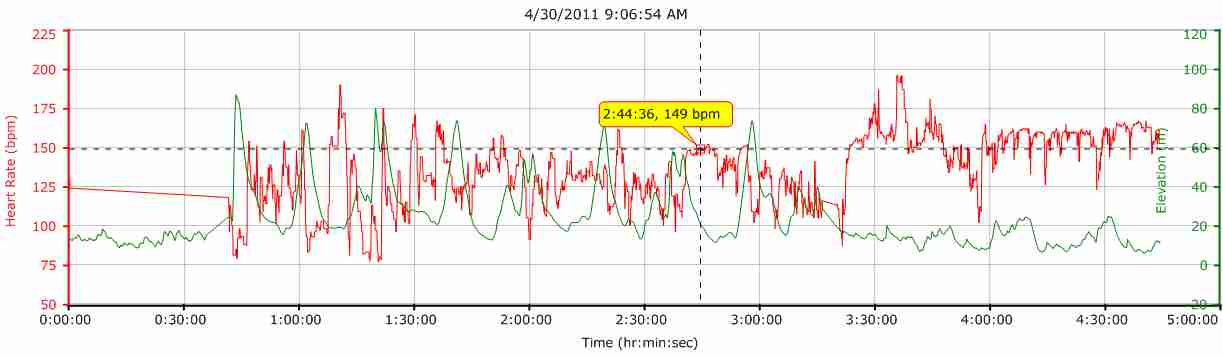

I was 84th overall (out of about 650) which isn't bad, 21st in my age group but, on the run leg, I was 33rd overall! I know that a Triathlon is not won on one leg alone but the run leg being the last one does say something about how much gas was left in the tank.
The swim is obviously where I am lagging behind, not to mention the transistions! I don't remember being quite so lacksidasical in changing from one sport to another, but the results make it look as though I was taking it easy. In an event that lasts around 5 hours, I refuse to get all stressed about making the perfect transition - you are more likely to forget something vital and regret it later. According to my not so trusty anymore Garmin, the swim was 2.27km in 35:40 but, even if I did stray from the course a litttle, it is bound to have exaggerated the distance due to GPS error. What I find more striking is that I seem to have lost nearly a minute struggling to get out of the water and tripping over the red carpet. For what its worth, you can compare the swim route with the one I actually did.


If you ignore the top right hand corner where it looks like I took a dip in the middle of my transition (maybe that explains it!), I think the line I took is pretty good - you have to remember that there are a lot of people in the way so it isn't always possible to go in the direction you want to. Perhaps those extra 300 meters come from some fractal wobbling (how long is the coastline of Britain?, that kind of thing). I'd be interested to know what readouts other people got, but I don't suppose anyone else was quite so nerdy as me, to have put their Garmin in their swimcap.
Senin, 02 Mei 2011
Week 16 / 20
There's not a great deal to say about last week that hasn't been said already.
After the race it was nice to have a few days off to wander round Lisbon with the family. Lisbon is a city that has something special for me: I have been there for work, I have been invited to deejay there, I have taken my wife on a romantic weekend there and, of course, I have competed in a Triathlon there. It was just a shame that it was raining pretty much the whole time. It was just as well that I had chosen to dress my bike in all season tyres. I was just beginning to have that confidence that I wouldn't get a flat again - thankfully I didn't have any mechanical or pneumatical problems in the race - when, after stopping for lunch on the way home, I found the rear tyre had just spontaneously deflated. How is that possible? (It was inside the car.)
POSTDATA: I just got around to sorting out the tyre for my ride this weekend and I was amazed to find that, yes, I did have a puncture! It seems very unlikely that I could ride 90km without any problems and that I should get a puncture just wheeling the bike out of the hotel, but it look like that is what happened! Thank goodness I didn't have any problems in the race.

As far as aches and pains go, I am raring to continue my training already. The only bothersome thing is a rash on my neck from my wetsuit rubbing during the swim.
It's a mark that all triathletes seem to bear, as if we had all been abducted by aliens. When you finish you look forward to the shower afterwards but some 5 seconds after stepping into the spray of water you feel knives jabbing you in all those places you neglected to put Vaseline beforehand. Now I have the above photo I'll be better prepared for the Ironman...
After the race it was nice to have a few days off to wander round Lisbon with the family. Lisbon is a city that has something special for me: I have been there for work, I have been invited to deejay there, I have taken my wife on a romantic weekend there and, of course, I have competed in a Triathlon there. It was just a shame that it was raining pretty much the whole time. It was just as well that I had chosen to dress my bike in all season tyres. I was just beginning to have that confidence that I wouldn't get a flat again - thankfully I didn't have any mechanical or pneumatical problems in the race - when, after stopping for lunch on the way home, I found the rear tyre had just spontaneously deflated. How is that possible? (It was inside the car.)
POSTDATA: I just got around to sorting out the tyre for my ride this weekend and I was amazed to find that, yes, I did have a puncture! It seems very unlikely that I could ride 90km without any problems and that I should get a puncture just wheeling the bike out of the hotel, but it look like that is what happened! Thank goodness I didn't have any problems in the race.

As far as aches and pains go, I am raring to continue my training already. The only bothersome thing is a rash on my neck from my wetsuit rubbing during the swim.
 |
| This photo will be useful to know where to apply the vaseline exactly before the Ironman |
Minggu, 01 Mei 2011
Lisbon Half Ironman race report
Race day started with breakfast at 6am in the hotel with Juan and Mario. I had what I would normally eat - a croissant and a bowl of muesli - plus a water bottle with a couple of sachets of High5 Energy 2:1. These sachets proudly claim to contain fructose which, after having read an article last week from the New York Times on the evils of corn syrup, reminded me a little of how packaged food in India is sometimes emblazoned with the slogan "now with additives!". In the end, we are at the mercy of the food industry however hard we try to be ahead of the curve. I may not have the heart, lungs or legs of an elite triathlete, but I reckon I do have the digestive tract of one.
One really good way of making friends at a Triathlon is to bring a roll of toilet paper. One of the guys I "lent" a length of paper to waved to me every time we crossed each other on the run. I was, however, still standing in the queue for the bogs (I think this is an appropriate term) - there were only 4 portaloos for 800 athletes - with only 15 minutes to spare. I always find it extremely satisfying to be able to jettison a bit of excess cargo at the last minute. I think the pre-race nerves must be to thank for my ability to do this - and yet I have never needed to "go" in any race so far. I expect the Ironman will change that (for this reason I bought a two piece racing suit).

I made it to the start of the swim with thankfully just enough time to jump in the water and get accustomed to the temperature. Unlike last year, the weather was pretty grim with some heavy storms leading up to the race, so it was fairly cold. I'd read that it made a big difference to get used to the water before starting the swim and, indeed, I felt my heart racing at first. The swim in Lisbon is in a kind of massive tank of sea water which is the best of both worlds as you get the benefit of the extra floatability from the salt water but without the waves. I put my Garmin in my swim cap so I could later see how much I meandered from the course. The gun went off and immediately the sound of 1,600 arms splashing in the water. I don't know why I bother practicing swimming technique frankly, when it is quite impossible to swim well with someone's feet in your face, someone else's arm clobbering you and a third person catching your ankles, but this is triathlon... I just tried to keep calm, keep my strokes long and my breathing regular. The good thing about this kind of suffering is that it does eventually end. There were moments when I could feel the panic starting to rise but I managed to keep it down. The worst I have ever felt in my life was in a diving course, taking my mask off under water, when the freezing cold water made me inhale through my nose and start to shake with utter panic. I went rushing up to the surface with the instructor clinging to my leg. Before inevitably going down to do it again, I talked to an experienced diver who simply said that the human body was not designed for this and that diving was a constant state of controlled panic. Well, I think much the same can be said of the swim leg of a triathlon. My Garmin beeped to tell me I had swum 2,000 meters already (my scenic route was a bit longer than the standard 1,900) and I could just make out the final buoys and the other athletes scrambling out of the water. I started to think about Neil at this point and an image came to mind from a photo I have of him gritting his teeth while climbing a hill on his bike. Finally I could feel the ground coming up underneath and I tried to stand up but it was so slippery and slimy that I dived back to swim the last couple of meters to the red carpet. The carpet was in such a bad state by now that I tripped and slipped again. There was a guy helping people up but he was busy with other people. I eventually got out and started to unzip my wetsuit. I looked at the time on my Garmin and, amazingly I was three minutes faster than last year: 35 minutes! All that seemingly random swimming training must have paid off. I jogged to my bike and got ready for part two.
Thank god Carlos had seen me earlier just before I racked my bike. He said "Where are you going with the smallest cog and big chainring? Maybe you can start like that but...". I decided not to bother with the fancy shoes attached to the bike transition and ran instead to the mount line with them on. This was when I discovered that my Garmin had been replaced by a random number generator. Not only did it sometimes show ridiculously high numbers as had been happening recently, but it also registered impossibly low numbers so it really was totally useless. Having no reference for how hard I was working other than the sensation in my legs and how heavily I was breathing, I went by 1 kilometer splits. Most of them were around 1:37 which is safely under the two and a half hours mark (yes, I was still able to do mental arithmetic at this point). But with the modest hills, turns and faffing around with water bottles and cereal bars, the laps were taking me 40 minutes, implying a time of 2:40. Considering I did 2:31 last year this was slightly demoralizing but I decided I would more than make up for it later on the run. The bike course was fairly uneventful apart from ejecting a water bottle after hitting a bump and later dropping half my cereal bars which had become a sticky mess after my not so wise decision to remove all the wrappers beforehand. The course is an ugly but flat out and back with the only thing to break the monotony being a fowl stench emanating from a factory along the way. You end up coveting the other competitor's bikes or wondering why someone riding an extremely aero bike with an aero helmet should choose to wear a jacket that acts as a parachute. Still, looks can be deceiving: there was a guy with an enormous bushy beard that looked like it would be quite effective as a fishing net - he ended up third in my age group! Every time I cycled back into town I would scan the crowd to see if I could spot my family and, as I was finishing the 3rd lap (of 4), I saw them there and waved frantically to them. What a difference it makes to see your loved ones at a time like that! I felt overwhelmed with emotion and adrenalin. What I didn't know until after the race is that Luca, my eldest son, had crossed the road and very nearly been hit by a cyclist - it took him about an hour to get over the shock.
I got to the bike rack after 2:35 and put on my running shoes. No visor or sunglasses today as it was raining. It wasn't the ideal race in terms of preparation for Brazil, which will no doubt be much hotter. In fact, I drank about half what I had planned to drink on the bike, supplemented instead with some 5 High5 Isogels, and I only gulped down about 6 salt tablets in the end, none of these on the run. I almost forgot to put on my race number which would have been a serious downer - on the bike it wasn't necessary and I'd forgotten to even take it out of my bag. I felt great on the run, as if I hadn't swum or biked just previously. I think only one or two people overtook me other than those who were a lap or two ahead anyway; I spent the race passing others all the way. It was just a question of putting up with the discomfort until it was over. The run is always a bit confusing, with people in all different stages of the race, but it is where you see everybody else for the first time. Apart from Carlos, Juan and Mario, some friends from my triathlon club, Aguaverde, there were about 10 people from work to wave to, not to mention those who I furnished with toilet paper before the race. I felt very strong but decided not to step up the pace for the second half so as not to leave myself in a lamentable state for the Ironman. I did the Half Marathon in 1:24! Actually, the run course was about 800 meters short so that's not quite as ridiculously good as it looks (remember my best Half Marathon time is 1:23) but it was good enough to get me to the finish line in 4:44, 20 minutes faster than last year. I felt overcome with emotion as I crossed the line - I craughed as I have done in the last three races I've done, a combination of relief, joy and exhaustion. It's an incredible feeling. It is why I race.
Langganan:
Postingan (Atom)