Tampilkan postingan dengan label races. Tampilkan semua postingan
Jumat, 24 Februari 2012
Selasa, 21 Februari 2012
Senin, 20 Februari 2012
Seville Marathon post mortem
As you can see I was 50th in my age group (I would have been 20th if I had been born just two months and a day earlier) and in the top 200 overall out of 5,500. Not bad!
Here you can see how my Marathon times have been improving. To make it a little bit more realistic, I've added in a dotted line to show what my expectations at the time were. The disappointments and surprises have got smaller and my overall time has got faster.
| The dotted line is what I was aiming for; the solid line is what I achieved |
Now this theoretical limit is based on my maximum pulse rate (191) and statistics gathered by my trainer from optimal (personal best) performances of hundreds of runners. Alternatively, you can base the same analysis relative to the anaerobic threshold which, in my case, is at 178 bpm. This paints a different picture as you can see below.
So I think there are two potential sources for a little improvement. The first is to go back to running to my heart rate in the second half of the Marathon, as it is a more reliable (and immediate) guide than pace. The second is that, while I don't know if I could realistically maintain 169 bpm for the first half of the Marathon without paying for it dearly in the second, given the way I finished the race yesterday, the graph above does make it look as though there is some margin to push a bit harder a bit earlier. I can't say that I could have run the last bit of the race much faster but the fact that I held it together and was able to work at that cardiovascular level without any muscular problems gives me the confidence to think about "starting the race" earlier than 7 kilometers before the end.
Minggu, 19 Februari 2012
Seville Marathon 2012 / Maratón de Sevilla 2012 - race report
The hotel was surprisingly quiet at 6:30 when I went down for breakfast. I had what I usually have for breakfast plus a couple of gels and a red bull for good measure... It doesn't make sense to me to eat something "special" on race day. I had time to go back to my room and watch an episode of The Wire before going down to meet my friends. I started to get slightly worried when I realized that they were still faffing about with their bags with only ten minutes to go before the start, so I took my last couple of pre-race gels and started running on the spot to warm up. It turned out that the Marathon was actually starting at half past nine, half an hour later than I had thought! Even so, I didn't really get much of a chance to warm up and we had to fight a little to squeeze in near the front of the start. In the end, the start was so chaotic that I lost all contact with the others so might just have well done my own thing!
The first couple of kilometers were a bit fraught but I figured that there were plenty left to be able to make up some lost time. I concentrated on keeping my heart rate at the magic 163 bpm level for the first half of the race. This got me to the halfway point in a time of 1:27. It was nice, for once, to know that the balloon marking the 3:00 Marathon pace was safely behind me. The first half went by almost without incident but, just as I passed the 14 km marker, I felt a worrying twinge in my right hamstring. It had been bothering me ever so slightly in the last few training sessions and I thought "OK, so you are going to be the f€&@er that bites me at 35 km". I decided not to waste precious mental energy thinking about it until then.
I felt pretty good at the Half Marathon point considering I had 21 km at about 4:05 per km in my legs. I thought to myself that this second half would only hurt as much as a stand-alone Half Marathon. Then something unexpected happened: I caught up with David Serrano. Serrano was debuting in the Marathon but there were high hopes for him to run a fast time (sub 2:50). He told me that he had already hit a bit of a wall and that he was going to play it safe. I wish I had been that sensible the first time I ran a Marathon: it is to much to ask to be able to run what you are capable of on the first attempt. I decided to press on at my own pace - when I slowed at the 35 km mark, perhaps David would be there to help pull me along. I took heed from what he said and decided to run the second half a little more conservatively, just in case. I never really found a group to run with and I am really picky about who I tail: not too slow, not too bouncy, not too heavy footed. I found one guy whose rhythm I liked but he seemed to find my presence behind him annoying as he started weaving from side to side, as if we were in contention for a place on the podium. Once my heart rate had steadied I made a push and left him behind (I would have been a good wind break for him, had he kept up).
Kilometer 35 was approaching and this time I was ready for whatever kind of obstacle it was going to serve me up. I thought that this was going to hurt as much as a flat out 7 km race and switched to my locomotive breathing style. I don't know how fast I was running because I had stopped pressing the lap button on my watch and I didn't even care to know what my pulse rate at this point was. I didn't even care too much what time I did, I just wanted to get it over with as soon as possible. I remembered a phrase the taxi driver the night before had said, "Para presumir, hay que sufrir" - "In order to boast, you have to suffer".
By this point in the race, it was showing 18 degrees on the thermometers. Even so, I had almost enough to drink with my two little bottles of isogels - I only took a small cup of Aquarius (pronounced here "Aquario") on two occasions. I didn't need any salt tablets or a mega carbo-load before as it turned out. Good to know for next time.
My pulse started to creep up an my breathing became more labored but muscularly I felt on top of the situation. I was passing a steady stream of people and working out in my head that all that was left was the equivalent of one series of 15 minutes at my anaerobic threshold and so on.
Finally, we entered the stadium and all that was left was half a victory lap an then my prize: a sub 3 hour finish time. As the clock came into view I realized that I could get just under 2:55 so I made a final effort and then it was over. Very chuffed with the result. More than the time, it was the satisfaction of a perfectly executed training plan and race strategy: in the end the second half was only a minute slower than the first.
Sitting outside on the grass, waiting for the others, I inspected the damage. My feet looked okay and the Compeed plaster - although it had stuck to the sock - had protected my foot from the beating. Practically no blisters, just a cut on a toe from a neighboring toenail was all.
Back in the hotel, I went for lunch in the restaurant with views of the finish line. I found it inspiring to watch all these people, each with their own story, their own suffering and their own supporters, struggling past. Now I feel I have tamed the Marathon (for now) I can see the beauty of it.
The first couple of kilometers were a bit fraught but I figured that there were plenty left to be able to make up some lost time. I concentrated on keeping my heart rate at the magic 163 bpm level for the first half of the race. This got me to the halfway point in a time of 1:27. It was nice, for once, to know that the balloon marking the 3:00 Marathon pace was safely behind me. The first half went by almost without incident but, just as I passed the 14 km marker, I felt a worrying twinge in my right hamstring. It had been bothering me ever so slightly in the last few training sessions and I thought "OK, so you are going to be the f€&@er that bites me at 35 km". I decided not to waste precious mental energy thinking about it until then.
I felt pretty good at the Half Marathon point considering I had 21 km at about 4:05 per km in my legs. I thought to myself that this second half would only hurt as much as a stand-alone Half Marathon. Then something unexpected happened: I caught up with David Serrano. Serrano was debuting in the Marathon but there were high hopes for him to run a fast time (sub 2:50). He told me that he had already hit a bit of a wall and that he was going to play it safe. I wish I had been that sensible the first time I ran a Marathon: it is to much to ask to be able to run what you are capable of on the first attempt. I decided to press on at my own pace - when I slowed at the 35 km mark, perhaps David would be there to help pull me along. I took heed from what he said and decided to run the second half a little more conservatively, just in case. I never really found a group to run with and I am really picky about who I tail: not too slow, not too bouncy, not too heavy footed. I found one guy whose rhythm I liked but he seemed to find my presence behind him annoying as he started weaving from side to side, as if we were in contention for a place on the podium. Once my heart rate had steadied I made a push and left him behind (I would have been a good wind break for him, had he kept up).
Kilometer 35 was approaching and this time I was ready for whatever kind of obstacle it was going to serve me up. I thought that this was going to hurt as much as a flat out 7 km race and switched to my locomotive breathing style. I don't know how fast I was running because I had stopped pressing the lap button on my watch and I didn't even care to know what my pulse rate at this point was. I didn't even care too much what time I did, I just wanted to get it over with as soon as possible. I remembered a phrase the taxi driver the night before had said, "Para presumir, hay que sufrir" - "In order to boast, you have to suffer".
By this point in the race, it was showing 18 degrees on the thermometers. Even so, I had almost enough to drink with my two little bottles of isogels - I only took a small cup of Aquarius (pronounced here "Aquario") on two occasions. I didn't need any salt tablets or a mega carbo-load before as it turned out. Good to know for next time.
My pulse started to creep up an my breathing became more labored but muscularly I felt on top of the situation. I was passing a steady stream of people and working out in my head that all that was left was the equivalent of one series of 15 minutes at my anaerobic threshold and so on.
Finally, we entered the stadium and all that was left was half a victory lap an then my prize: a sub 3 hour finish time. As the clock came into view I realized that I could get just under 2:55 so I made a final effort and then it was over. Very chuffed with the result. More than the time, it was the satisfaction of a perfectly executed training plan and race strategy: in the end the second half was only a minute slower than the first.
Sitting outside on the grass, waiting for the others, I inspected the damage. My feet looked okay and the Compeed plaster - although it had stuck to the sock - had protected my foot from the beating. Practically no blisters, just a cut on a toe from a neighboring toenail was all.
Back in the hotel, I went for lunch in the restaurant with views of the finish line. I found it inspiring to watch all these people, each with their own story, their own suffering and their own supporters, struggling past. Now I feel I have tamed the Marathon (for now) I can see the beauty of it.
Limping with both legs
2:54 in Seville Marathon! Broken 3 hours at long bloody last! Race report to follow soon...
Sabtu, 18 Februari 2012
Seville Marathon 2012 pre-race report
I've been continuing to get blisters on my foot this week, even after running only 30 minutes, so I decided to take action, risky action. The problem seemed to be coming from an island of hard skin that was causing the neighboring skin to ruck up. I decided to do something that is not usually advisable two days before a Marathon: I peeled it off. The skin underneath was too virgin to stand up to the rigors of a full Marathon, so I stuck a Compeed plaster on top and - touch wood - it seems to be holding up.
The logistics of this Marathon couldn't be easier. Seville is just a couple of hours away from Madrid by train - I took it as a good omen that the train departed from platform 7 and my seat was 7a in car 7. My hotel is actually in the Olympic stadium where the race finishes (although it would have been nice at the price I'm paying if they had reserved the room with a view of the track as I had asked for...). Just as I was checking in, a group of huge guys in sports kit came in - I thought, these guys don't look like Marathon runners. In fact, they weren't, they were a rowing crew from Czechoslovakia.
The expo, just around the corner (if the girl in reception hadn't sent me the opposite way round the outside of the stadium!), is noticeably more "cutre" (naff) than the one in Valencia. I bought some Wright socks which will hopefully put an end to this nonsense with the blisters (don't worry, I won't wear them for the first time in the Marathon!). Annoyingly, the t-shirts in my size had already gone - after 27 editions, you'd think they would have worked out the system of asking people to specify their size in the inscription form. In fact, as it is a vest rather than a t-shirt, medium may be a better size for me after all.
Anyways, it's all about the race tomorrow, these are just details but they are the sort of thing that make the difference between people choosing to run one Marathon or another. I hope the event itself is a little more professional.
So now I'm off to meet my recently acquired friends for the Last Supper of pasta (which I won't be eating again for a while). Then it's bed and... Well, you just have to log in again tomorrow to see how it went; I have to do this thing!
The logistics of this Marathon couldn't be easier. Seville is just a couple of hours away from Madrid by train - I took it as a good omen that the train departed from platform 7 and my seat was 7a in car 7. My hotel is actually in the Olympic stadium where the race finishes (although it would have been nice at the price I'm paying if they had reserved the room with a view of the track as I had asked for...). Just as I was checking in, a group of huge guys in sports kit came in - I thought, these guys don't look like Marathon runners. In fact, they weren't, they were a rowing crew from Czechoslovakia.
The expo, just around the corner (if the girl in reception hadn't sent me the opposite way round the outside of the stadium!), is noticeably more "cutre" (naff) than the one in Valencia. I bought some Wright socks which will hopefully put an end to this nonsense with the blisters (don't worry, I won't wear them for the first time in the Marathon!). Annoyingly, the t-shirts in my size had already gone - after 27 editions, you'd think they would have worked out the system of asking people to specify their size in the inscription form. In fact, as it is a vest rather than a t-shirt, medium may be a better size for me after all.
Anyways, it's all about the race tomorrow, these are just details but they are the sort of thing that make the difference between people choosing to run one Marathon or another. I hope the event itself is a little more professional.
So now I'm off to meet my recently acquired friends for the Last Supper of pasta (which I won't be eating again for a while). Then it's bed and... Well, you just have to log in again tomorrow to see how it went; I have to do this thing!
Rabu, 15 Februari 2012
Lactate test
What better way to spend the evening of Valentine's day than to do a lactate test? As last time, the protocol involved running 4 series of a kilometer around the track at a prescribed pace. Rather than relying on a GPS watch, the trick was to make sure I passed a cone every time the watch "beeped". The first two kilometers were run at 14 kph (conservative Marathon pace) and the second two were run at 15 kph (ambitious Marathon pace). Even if the numbers don't mean a lot to you (they don't to me), it is interesting to see the improvement since the test I did just prior to running Valencia Marathon:
Just judging by my heart rate, there is a clear improvement: I ran the second set at 15 kph with virtually the same heart rate as the second set at 14 kph last time round. My lactate clearing abilities have also improved for what that's worth.
With all that, Jonathan reckons that I can aim for a pace somewhere between 4:05 and 4:10 per kilometer but that, in any case, I should keep a close eye on my heart rate.
| Pre Valencia (November 2011) | |||||
| Speed (kph) | Lactate (mmol/L) | Heart rate (bpm) | |||
| 14 | 1.7 | 155 | |||
| 14 | 1.7 | 158 | |||
| 15 | 2.7 | 167 | |||
| 15 | 2.9 | 166 | |||
| Pre Seville (February 2011) | |||||
| Speed (kph) | Lactate (mmol/L) | Heart rate (bpm) | |||
| 14 | 1.2 | 153 | |||
| 14 | 1.4 | 149 | |||
| 15 | 2.3 | 159 | |||
| 15 | 2.2 | 160 | |||
| Pre Getafe (January 2011) | ||||
| Speed (kph) | Lactate (mmol/L) | Heart rate (bpm) | ||
| 15 | 3.2 | 158 | ||
| 15 | 2.2 | 159 | ||
| 16 | 3.9 | 166 | ||
| 16 | 4.4 | 170 | ||
With all that, Jonathan reckons that I can aim for a pace somewhere between 4:05 and 4:10 per kilometer but that, in any case, I should keep a close eye on my heart rate.
Selasa, 14 Februari 2012
Maratón de Sevilla 2012 / Seville Marathon 2012
Without wanting to sound like I'm blowing my own trumpet, I'd say that if I was asked in one of those typical job interview situations what my greatest strength was, I'd probably say that it is my determination. (Of course, they usually ask you what your greatest weakness is and there is always a way to make a weakness sound like a strength, like the classic "I'm a perfectionist". In the same way, being sheer bloody-minded has it's downsides too.)
The Marathon is not really my bag, my cup of tea, my "thing". You can see that just by looking at me. I've got the frame of a sprinter, not a long distance runner. I have more explosive power than endurance. I weigh too much. But I have a tendency to plug away at things I am (relatively) bad at, the idea being that it will help me be even better at the things I am much better at. In my Maths degree I found functional analysis baffling so I took the advanced course (which I struggled even more to understand) and, in the end, I got my best scores on the functional analysis paper.
After my first Marathon I said "Never again"; the second one was a complete surprise running the second half 7 minutes faster than the first; the third was again a disappointment (not counting the Ironman Marathon). There seems to be a oscillatory pattern developing here. I've come to realize that I needn't expect a complete meltdown (like in my first Marathon) nor is it realistic to expect that I will fly to the finish line without a hitch along the way. A friend summarized it in the best way I have seen:
"Running a Marathon is about enjoying X kilometers and suffering the last 42.195 - X kilometers as little as possible; training for a Marathon is about maximizing that X"
Unlike the last Marathon I ran (in Valencia), I am not going into this one expecting that I won't have to fight like a demon at some point (hopefully close to the end). I may lose a minute or two but, as my experience in Valencia showed me, once the finish line was psychologically in view, I was able to increase my speed again. They say the Marathon is 90% mental and this is what they mean by it. I didn't hit a wall - or at least not a hypoglycemic wall - but the central governor in my brain simply decided that enough was enough and that I had better have a good reason to say otherwise. That time I didn't, not until I realized that I was still able to get a personal best time even if it was no longer possible to break the three hour barrier. This time I want to make sure I have a damn good reason and be ready to state my case when the time comes to negotiate. I've come across several accounts of Marathons which don't appear to tell much of a story when you look at the splits - perhaps the second half was only a couple of minutes slower than the first half - but when you read the chronicle, you realize that most people have to struggle at some point. Arguably, if you don't then you simply didn't run it fast enough. The trick is to judge it exquisitely so that the struggle is one that you can win.
So I'm ready to fight! I'm also in the best shape I have been in for a while. My training has gone perfectly and I have surprised myself at how fast I have managed to run my series and some of my long runs. I have also learned that I will have to concentrate very hard to make sure my running technique is good for as long as possible and that I am keeping good pace. If I let my mind wander then I will become less efficient and I will start to run more slowly without even realizing. Where I am not going to invest my mental energy is in calculating how many gels I need to take in the carbo-loading phase (I am just going to eat lots of pasta) or how many salt tablets I am going to need (I'll just drink lots of Aquarius).
This Marathon is going to be mental.
Selasa, 24 Januari 2012
Rock 'n' Roll
I've wanted to run in the International edition of the San Silvestre Vallecana race held on New Year's Eve ever since I started running again, just over four years ago. It is another goal which has gone from being something that seemed unattainable to not being a "big deal" without me even realizing it. In fact, in 2009 I had the requisite sub-38 qualifying time of 37:45 in a 10k race I did in Fuenlabrada that year, but I was disappointed to discover that it wasn't one of the very few "homologated" races that the RFAE had certified.
This year I really am in two minds as to whether to run the International Sansi or the Popular one with my family. The last one, I ran with my wife and a friend who was accompanied by his two small kids for about 3 kilometers. I think my kids would really enjoy it. It is actually feasible if not a little ambitious to do both as the International race starts a couple of hours after the Popular edition. Although I'd want to run the International one as fast as I could so I could use the first few kilometers of the Popular one as a warm up with my kids, go back with them to the start on the metro and deposit them with a friend / family member who could look after them while my wife finishes her race and I prepare mine. Sounds a bit complicated already, especially for a New Year's Eve.
Anyway, the first step is to actually qualify. I've already broken 38 minutes in a 10k twice this year - technically, the first time was actually on the last day of last year on a unhomologated course and the second time was during a Half Marathon. There are actually very few homologated races in Madrid and some of these are too late in the year to guarantee entry to San Silvestre, for which the subscriptions open some months before. Looking on the website there was the option of travelling hundreds of kilometers to a race which, quite frankly, I can't be bothered to do (I'm already schlepping half way around the world for my races this year). The other option is to run the 10k in Madrid that starts alongside the "Rock 'n' Roll" Marathon - previously known as Mapoma. I've never run the Madrid Marathon - definitely something for the bucket list - but I have run half of it as a training run. The atmosphere is fantastic. It isn't, however, the flatest of courses.
So I've put myself down for the Rock 'n' Roll Madrid 10k on the 22nd of April, two days after my 40th birthday and - what is more of a potential hindrance - a week after the ICAN Half Ironman in Marbella. Well, if I am able to maintain my current form, running 10k sub-38 is like a medium intensity (CCM) run so it should be doable.
Hopefully my wife will also run. It looks like the sort of race that she would enjoy although, this time, she's on her own...
Senin, 23 Januari 2012
Minggu, 22 Januari 2012
It is all in your mind - Media Maratón de Getafe race report
| My pulse rate cheat sheet |
I have this very silly theory for why I seem to do better in local races that I drive to than in big races that I have to travel to by train or plane. And it's not the obvious explanation that it might be because I am more nervous about the big races or due to tiredness from traveling. No, it's because I sing in the car on the way to a race. You know, loud embarrassing singing that would definitely not be happening if there were anyone else within earshot of me. I reckon that this warms my lungs up and gets me psyched up for the race ahead.
I lined up more or less where I thought I would place, as usual, miscalculating for the fact that so many people bunch up at the last minute. The gun went off and the first kilometer or so was a mad scramble to run at a decent rhythm with so many people around who had clearly overestimated their abilities. In fact I spent pretty much the entire race overtaking people, I think I was only overtaken by one person the whole time.
This was the first time I ever ran in the same race as Jonathan so I was determined to do him proud. I set my watch up so I could see my pulse rate and the time I had been running but I specifically did not want to know the GPS measured distance; instead I went by the markers by the side of the road. It required relatively simple maths skills to run at 3:50 per kilometer - I just had to keep track of how much under the minute I was at each milestone (kilometerstone) and try to be 10 seconds below that at the next one. I found it pretty easy to keep rhythm and I just kept an eye on my pulse rate to make sure it didn't go too far above the guide written on the back of my hand.
I passed the 10k mark in a net time of 37:36 which is a personal best time for me for a 10k race! I was already about half a minute ahead of pace and I was feeling good. I was so "in the zone" that I didn't notice my family shouting for me the first two times I passed them.
When I got to the 15 kilometer mark I started to breathe a little harder and, by the 16 kilometer mark, I was now breathing my trademark "locomotive" style. A couple of friends running on the other side of the road called out my name, presumably because they recognized my distinctive breathing. Now I was very confident I would break the 1:21 mark, leaving the challenge of breaking 1:20 for another day. I'm not sure whether I was running faster or other people were fading, but I was certainly having to make a big effort. I overtook one guy who slapped me gamely on the back and said "Go machine!". Once I got to the final 96m straight, I could see from the clock that I was in with a good chance to break 1:20! I summoned up energy for a final spurt by shouting and swearing at the pain and discomfort and ran through the arches with a time of 1:19:45 (net 1:19:37)!! Unbelievable. According to the splits on my Garmin, I ran the second quarter Marathon just a couple of seconds faster than the first quarter.
It just goes to show that, sometimes, it is a question of believing you can do it (consciously and subconsciously). I think that the speed work I have been doing lately in the way of series has shown the "central governor" part of my brain that I can sustain a pace of very nearly 16 kph for 21 and a bit kilometers. Very happy with that performance.
Now I just have to translate it into an equivalent Marathon time...
Youness - with whom we went to Morocco - came in fifth overall with a group of international standard runners. Jonathan missed breaking 1:13 by four seconds. Everyone else I talked to seemed to be pretty happy with their performance. I got a feeling, that 2012 is gonna be a good year...
Minggu, 01 Januari 2012
San Silvestre(s)
![]() |
| I'm right in the middle, starting more or less where I finished |
| I can actually remember taking this step (I didn't get wet by the way) |
| I said I was going as "Abba" not as "un haba" (bean) |
| With my wife just before the race |
| People throwing away the extra layers of clothes |
Sabtu, 31 Desember 2011
Happy New Year!
This morning I ran my first of two San Silvestre 10k races in Las Rozas de Madrid. I was convinced it was going to be absolute chaos with 800 runners doubling back on narrow paths through the woods but there didn't seem to be any problems, in spite of the trail being quite steep and technical in parts. Considering I haven't really trained for the distance and it's been exactly a year since the last time I ran a 10k race, I was quite happy with my time of 37:54, especially as the course was really cross country. I finished in 21st place out of 800 which isn't bad. Nobody overtook me during the whole race with the exception of someone who pipped me on the line with an awesome sprint that I couldn't match. I still prefer the Half Marathon distance which isn't so stressful. I do feel as though I have earned my celebration tonight, though. As a friend said after completing the race this morning, we have to pull ourselves back down by eating and drinking otherwise we'd become too competitive and have to make a living from athletics...
This afternoon I have the second San Silvestre "race" - the Vallecana - with about 38,000 other runners including my wife. I'll be getting dressed up for the event so check back here tomorrow for the photos! In the meantime, happy new year to all of you!
Rabu, 07 Desember 2011
Race calendar 2012
I decided that I couldn't end the year without a full-on 10k race as is customary on San Silvestre (New Year's Eve). As I'll be running the San Silvestre Vallecana (the big one organized by Nike with 30,000 runners) with my wife at a modest pace and probably dressed as one of the guys from Abba, I thought I would sign up for another 10k race in the morning that I will race at full speed.
31st December 2011
San Silvestre Las Rozas 10k (fast)
San Silvestre Vallecana 10k (slow)
22th January 2012
Getafe Half Marathon
19th February 2012
Seville Marathon*
15th April 2012
Marbella Half Ironman* (ICAN Marbella)
16th/23rd September 2012 (approx)
Valladolid Half Marathon
4th November 2012New York Marathon
* "A" races - the important ones for which the other races are just preparation or "fun"
31st December 2011
San Silvestre Las Rozas 10k (fast)
San Silvestre Vallecana 10k (slow)
22th January 2012
Getafe Half Marathon
19th February 2012
Seville Marathon*
15th April 2012
Marbella Half Ironman* (ICAN Marbella)
16th/23rd September 2012 (approx)
Valladolid Half Marathon
4th November 2012New York Marathon
* "A" races - the important ones for which the other races are just preparation or "fun"
Senin, 05 Desember 2011
Maratón de Sevilla 2012 (Seville Marathon)
If you remember, I have been wondering how to achieve two potentially conflicting goals next year: run New York Marathon and break the 3 hour barrier in the Marathon. Conflicting, because New York Marathon is a fairly tough one and would probably add something like 3-6 minutes to my time, making it that much harder to break three hours. Also, I want to enjoy the New York Marathon - you know, actually look around and enjoy having the road to myself (and 39,999 other people).
My trainer has given his blessing to the idea of squeezing in a Marathon in February, in spite of having the Half Ironman in Marbella (ICAN) in April. This also means that I'm not going to get much of a respite from structured training. A friend asked me the other day if I didn't feel like I needed a break, at least mentally. The fact that I was taken aback by his question makes me think that I don't need much of a break. In fact, given my condition last week (from chaffing), I told him I was actually missing being able to go for a run. I actually like running which is just as well as preparing for another Marathon means more long runs and series.
I've mentioned before the tendency I have noticed to lose respect for a difficult goal during the preparation. In order to be able to attack the goal (e.g., complete an Ironman or break 3 hours in the Marathon) you have to train, obviously, and as you become fitter you gain confidence in achieving that goal. Here comes the rub: if you are really well prepared then there is a point at which you feel so sure that you will achieve that goal that it almost doesn't seem like a BIG DEAL anymore. You start to feel as though you have already achieved it. Of course you have to expect to achieve it to have a real chance of achieving it but not to the point that you don't reap the rewards of actually achieving it. In other words, you should not fear your goal but you must respect it. One of the good things about my "failure" to achieve my goal of 3 hours in the Marathon last week is that it has made me respect it. Oh yes, I think this time, if I do actually manage to break it - which I think I deserve to do and I think I am definitely capable of doing - the victory will be so much sweeter!
Seville Marathon is on the 19th February which gives me just over two months to prepare for it. I expect I'll have to do some swimming and biking in parallel so that I don't arrive at the start line in Marbella having forgotten everything I know about Triathlon. The course is nice and flat and the temperature should be similar to that in Valencia. The advantage that I will have is that Seville is where I got married just over ten years ago. We chose the place simply because it is a very special place and not because we have any connection there. The course looks nice and is very unusual in that there are no loops or repeated sections.
Now I just need to discuss my goals with my wife. I've found that things are much smoother if they are agreed in advance: after all, these commitments have an impact on the whole family, not just on me.
Senin, 28 November 2011
Valencia Marathon: Post Mortem and Photos
Post mortem
The last post on the Marathon, I promise, but I have to exorcize my demons...
Here are the official results from the Marathon webpage:
One thing that is quite interesting is that I finished only one place behind the position I was in at the 15k mark (and, incidentally, only six places behind my starting position)! That means that my fade was pretty much par for the course. Compared to my target pace for a sub 3 hour Marathon you can see I was pretty much on the money (only just) until kilometer 34 - I even managed to get slightly ahead of pace in the beginning of the second half which was ever so slightly downhill.
Just for info - because a Marathon is about crossing the line, not clocking up 42,195 meters on your GPS watch - my Garmin reckoned I ran the first half at an average pace of 4:12, some 5 seconds per kilometer (and two whole minutes) faster than my actual pace. Things seemed to even out somewhat over the second half because my average pace according to Garmin was 4:22 while my real pace was 4:25. This is why it is a good reason to ignore the GPS altogether and to press the good old fashioned "lap" button manually every time you pass a kilometer (or mile) marker. Here's the graph of my heart rate and pace during the Marathon - you can see exactly where things started to go pear shaped.
If I go by my Garmin GPS, I ran the first half 6 seconds per kilometer more slowly than I ran the Half Marathon in Miguelturra two weeks ago and at a "cost" of 3 heart beats per minute more on average. If I go by the distance according to the organizers, the difference was 11 seconds. Supposing that Valencia was measured properly and Miguelturra was a bit short, the difference comes to 10 seconds per kilometer which equals - lo and behold - 7 minutes over the course of the Marathon. So it required more effort to run 7 minutes in a Marathon more slowly than I was running only two weeks ago and at 600 meters higher altitude (although it was a couple of degrees cooler). So it wasn't just a feeling, there was definitely something wrong. And the cruel thing about the Marathon that almost everyone who has ever run one knows, is that if you run a few minutes ahead of pace in the first half, you pay it back with interests that would make even a loan shark blanche.
Things I have learned from this experience:
- Don't wear triathlon shorts unless they are liberally slathered in chamois cream.
- If your pulse is higher for a given pace or your pace lower for a given pulse it means something is up. Don't run to pace, run to pulse. In fact, I think I may not even press the lap button or look at the time next time I run a Marathon.
- If I need to dig deep, I can, and without cramping. So if I ever find myself on for a time of 2:55, say, and fading, I can still make it to the finish before the clock strikes 3. Be prepared to fight.
- I should put vaseline on TOP of my toes which is where I tend to get blisters with the Vivobarefoot Ultras.
- I can run a Marathon with extremely minimalist shoes without any problem, running on the balls of my feet the whole way.
- The kilometers from 1-34 went ticking by very quickly. I was surprised how little I had to wait before the next one popped into view.
- As long as it is no hotter than 20 degrees, I don't need to drink much more than the 9 High5 Isogels I took. I drank a little water every 5k at every station after the 10k mark just to be on the safe side.
- More important than beating an arbitrary time (like 3 hours) is beating your own best time.
What next?
Apart from running the 10k San Silvestre race with my wife on New Year's Eve, the next goal is the Half Ironman in Marbella in April next year. I'm looking forward to getting back on the bike even if it isn't really the best time of year for it. On Saturday I have a bike fitting and my priority is healing my undercarriage from the chaffing so that I can actually sit on a bike seat in relative comfort.
Then the question is how I can achieve two potentially conflicting goals: (1) run NY Marathon 2012 and (2) break the @#%€&! 3 hour barrier. Why conflicting? Because NY Marathon is not well known for its easy flat course so breaking 3 hours in NY is that much harder. If I am in as good a shape as it looked as though I was before Valencia, even that should be possible. I'm looking into various options like
1) Running NY at 3:30 pace, maybe pacing a friend, as a "long steady run" and then racing in San Sebastian 3 weeks later.
2) Squeezing in a Marathon in February in Seville before focusing on the Half Ironman.
3) Going for sub 3 in NY.
none of which seem too sensible. I have plenty of time to decide but I like to have my goals set well in advance.
Some photos...
The last post on the Marathon, I promise, but I have to exorcize my demons...
Here are the official results from the Marathon webpage:
One thing that is quite interesting is that I finished only one place behind the position I was in at the 15k mark (and, incidentally, only six places behind my starting position)! That means that my fade was pretty much par for the course. Compared to my target pace for a sub 3 hour Marathon you can see I was pretty much on the money (only just) until kilometer 34 - I even managed to get slightly ahead of pace in the beginning of the second half which was ever so slightly downhill.
| Kilometer | Target | Actual | Difference |
| 10 | 00:42:40 | 00:42:58 | -00:00:18 |
| 15 | 01:03:59 | 01:04:13 | -00:00:14 |
| 25 | 01:46:39 | 01:46:34 | 00:00:05 |
| 30 | 02:07:58 | 02:08:13 | -00:00:15 |
| 35 | 02:29:18 | 02:29:59 | -00:00:41 |
| 40 | 02:50:38 | 02:55:47 | -00:05:09 |
| 42,2 | 03:00:00 | 03:06:40 | -00:06:40 |
Just for info - because a Marathon is about crossing the line, not clocking up 42,195 meters on your GPS watch - my Garmin reckoned I ran the first half at an average pace of 4:12, some 5 seconds per kilometer (and two whole minutes) faster than my actual pace. Things seemed to even out somewhat over the second half because my average pace according to Garmin was 4:22 while my real pace was 4:25. This is why it is a good reason to ignore the GPS altogether and to press the good old fashioned "lap" button manually every time you pass a kilometer (or mile) marker. Here's the graph of my heart rate and pace during the Marathon - you can see exactly where things started to go pear shaped.
If I go by my Garmin GPS, I ran the first half 6 seconds per kilometer more slowly than I ran the Half Marathon in Miguelturra two weeks ago and at a "cost" of 3 heart beats per minute more on average. If I go by the distance according to the organizers, the difference was 11 seconds. Supposing that Valencia was measured properly and Miguelturra was a bit short, the difference comes to 10 seconds per kilometer which equals - lo and behold - 7 minutes over the course of the Marathon. So it required more effort to run 7 minutes in a Marathon more slowly than I was running only two weeks ago and at 600 meters higher altitude (although it was a couple of degrees cooler). So it wasn't just a feeling, there was definitely something wrong. And the cruel thing about the Marathon that almost everyone who has ever run one knows, is that if you run a few minutes ahead of pace in the first half, you pay it back with interests that would make even a loan shark blanche.
Things I have learned from this experience:
- Don't wear triathlon shorts unless they are liberally slathered in chamois cream.
- If your pulse is higher for a given pace or your pace lower for a given pulse it means something is up. Don't run to pace, run to pulse. In fact, I think I may not even press the lap button or look at the time next time I run a Marathon.
- If I need to dig deep, I can, and without cramping. So if I ever find myself on for a time of 2:55, say, and fading, I can still make it to the finish before the clock strikes 3. Be prepared to fight.
- I should put vaseline on TOP of my toes which is where I tend to get blisters with the Vivobarefoot Ultras.
- I can run a Marathon with extremely minimalist shoes without any problem, running on the balls of my feet the whole way.
- The kilometers from 1-34 went ticking by very quickly. I was surprised how little I had to wait before the next one popped into view.
- As long as it is no hotter than 20 degrees, I don't need to drink much more than the 9 High5 Isogels I took. I drank a little water every 5k at every station after the 10k mark just to be on the safe side.
- More important than beating an arbitrary time (like 3 hours) is beating your own best time.
What next?
Apart from running the 10k San Silvestre race with my wife on New Year's Eve, the next goal is the Half Ironman in Marbella in April next year. I'm looking forward to getting back on the bike even if it isn't really the best time of year for it. On Saturday I have a bike fitting and my priority is healing my undercarriage from the chaffing so that I can actually sit on a bike seat in relative comfort.
Then the question is how I can achieve two potentially conflicting goals: (1) run NY Marathon 2012 and (2) break the @#%€&! 3 hour barrier. Why conflicting? Because NY Marathon is not well known for its easy flat course so breaking 3 hours in NY is that much harder. If I am in as good a shape as it looked as though I was before Valencia, even that should be possible. I'm looking into various options like
1) Running NY at 3:30 pace, maybe pacing a friend, as a "long steady run" and then racing in San Sebastian 3 weeks later.
2) Squeezing in a Marathon in February in Seville before focusing on the Half Ironman.
3) Going for sub 3 in NY.
none of which seem too sensible. I have plenty of time to decide but I like to have my goals set well in advance.
Some photos...
![]() |
| Trying to spot my family in the crowd |
![]() |
| I finally got to grit my teeth |
A wish come true...
Remember how I was saying that I almost hoped that I'd get sick, at least that way I'd have an explanation for why it was harder for me to maintain that pace than I'd been accustomed to? It's not an "excuse" I want, it's an explanation so that I can confidently pace myself in my next Marathon. Well, it looks like my wish has come true. I think I'm going to go home this afternoon and hopefully I'll be better soon.
The question I have now is: do I do New York Marathon (for which I will get an automatic entry through the lottery system next year) or do I do a winter Marathon that is a bit easier? Alternatively, I could try to squeeze in a Marathon in February - in Seville, for example - before the Half Ironman in Marbella.
Minggu, 27 November 2011
Race report
I got up about 3 hours before the 9am start and went down to have breakfast. To pass the time and to put me in the mood before the race, I read Kilian Jornet's book "Run or die" (I'll write a review on this when I finish it, but it hasn't been translated into English yet).
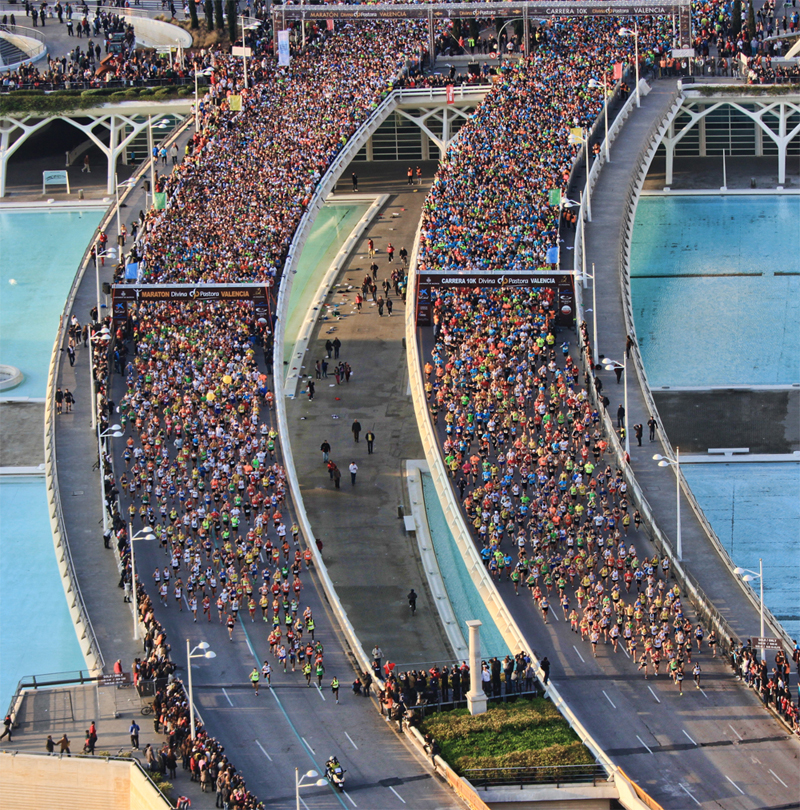
I managed to get a good slot up near the front of the 12,000 or so runners. It's a testament to the organization that I was not at all hindered at any point in the race in spite of there being a 10k race being run in parallel.
However, things didn't bode too well right from the start although, of course I knew there were plenty of kilometers left in which things could take a turn for the better. After only a kilometer I noticed the tendon on the top of my right foot was getting sore - probably related to the pre-race problems I had been having - and it didn't get better during the race. I don't think it had any material impact on my performance though. More seriously, I noticed that my pulse rate was higher than it had been only two weeks ago in Miguelturra, and at a slower pace. The kilometer markers came past at a depressing few seconds slower than the pace at which my Garmin GPS would have me believe I was running at.
I decided to take a slightly risky decision once it was clear that I was running below the necessary pace to beat the 3 hour mark. I allowed myself to run only 2 heart beats per minute faster than I had planned. I remembered that Jonathan had told me that I had some margin in the projected heart rate due to my relatively high anaerobic threshold. This was just enough to be able to cross the halfway mark at 30 seconds over my target of 1:30. I consoled myself by remembering how I had managed to run the second half much faster than the first last year.
The Marathon is a cruel and arrogant master. Just when I thought I was beginning to get it under control, it put me back in my place again, to remind me that anything can happen in a Marathon. I was still running well at the 32km mark where my family were waiting for me (and where the photo in the previous post was taken). But around the 35km mark where a guy was playing the drums next to a banner that said "Knock the wall down", I hit it. Not hard, but that kilometer took me 15 seconds off pace and the next, even more and so on. My pulse rate began to drop and my breathing became more laboured and my legs heavier and heavier. I started pumping my arms more. I ran for some stretches with my eyes closed. I started to get grumpy. A guy bumped into me at one of the water stops and told me not to stop: I angrily replied that I was not stopping. At least that much was true: I didn't stop, not once, and I didn't suffer any cramps. Only 4 or so kilometers before the end, a man rather unwisely decided to cross in front of me on his bike with his small children - who didn't know any better - in tow. I had to bark at them to avoid crashing into them.
As the finish line drew labouriosly closer, I realized that it was at least possible to beat my best time in the Marathon from last year. That was something. I also didn't want my kids to see me shuffling pathetically past. I administered myself an adrenalin injection by shouting obscenities at the Marathon in front of a cheering crowd and was able to surge forward if only for a couple of hundred meters. It was definitely worth it because, apart from being the boost I needed to get a personal best time, it made me feel some emotion even if it was mainly anger and frustration.
As I said in my previous post, I ended up doing the reverse of last year's Marathon: instead of a second half 7 minutes faster than the first, I did a second half 7 minutes slower. My wife asked me if I was disappointed with my time which, after all, was only 7 minutes slower than my target, and a best time at that. I said no, I wasn't, but I was very disappointed to have not been in control. I don't think a race in which you have to run through treacle randomly deposited somewhere along the course would catch on as much of a "fun" idea but this is what the Marathon is unless you can find a way to outsmart "el hombre del mazo" (the sledge hammer man). I wonder if this distance is for me. What I mean by this is - I wonder if I have to go through that frustrating torture of running ever more slowly in order to run to my best (which is a non-negotiable condition that I impose on myself). Or maybe I should just run Marathons well within my pace so as to enjoy them. The thing is, even then I am not sure I wouldn't hit the wall: you burn more or less the same calories per kilometer no matter what pace you run at (within reason). I'd almost be glad to come down with whatever my kids have got - at least then I'd have an explanation and a good reason to try again.
I tend to get a bit discouraged after a disappointment but I quickly bounce back. I'm thinking that you have good days and bad days and part of the art of training is to ensure that the day of the competition is one of those good days: maybe today it just wasn't so, as my slightly elevated pulse seemed to hint at. I think I will try running my next Marathon strictly below the prescribed pulse rate and see what result I get. Or I can avoid hitting the wall that is already an accomplishment; eventually I'll have a "good day" and get below that magic barrier of 3 hours.
Valencia is a wonderful city and it's a shame we didn't get a chance to enjoy it much between the Marathon and the kid's temperature. This afternoon has been a bit stressful with my wife having to rush off to Mali (where 7 people were kidnapped last week, by the way) while we have to wait several hours amongst screaming sickly children in the hospital. Still, the kids are being very good and claim to have enjoyed the weekend in spite of everything.
PS: You can watch my crossing the line (at 3:06:54) here. At least I looked in better shape than the guy being carried over the line in a stretcher.
PPS: I find that you can never put enough vaseline or there is always a bit you forget about. Remind me not to run in those shorts again for a Marathon (they were OK in the Ironman but then you expect to be saddle sore). I'm walking like John Wayne as a result.
Valencia Marathon results
I did the opposite of last year: instead of doing the first half in 1:37 and the second in 1:30, I did the first half in 1:30 and the second half in 1:37. It is a lot more enjoyable doing it the other way round, I can tell you: I hit the wall in kilometer 35 and it was clear that I wasn't going to make my target of sub 3 hours but at least I beat my best time - just, by about 30 seconds.
I'll do a full write up soon.
Sabtu, 26 November 2011
The expo
I've just been to pick up my race number from the expo. The usual stands were there but I was struck by two things. Firstly, the whole minimalist shoe thing was in full swing. In fact, I'd say that there were more minimalist offerings than there were "traditional". I overheard someone on the Merrel stand explaining their line of "barefoot" shoes to which the response was "it looks like you are going back to what we used to run in". There was Vibram, of course, but a stand showing off some "shoes" that looked to me more like brightly colored verruca socks caught my attention. They are made in Spain by a French company called one moment (www.onemoment.es) and are designed as a kind of post-Marathon shoe but have found uses in anything from boating to beach wear. At around 5 euros a go, they look like a great option for wandering down to the start of a Triathlon and, as they are cheap and biodegradable, you don't really care too much about getting them back. Shame they don't make them in my size.
The other trend that caught my attention was the proportion of stands dedicated to Triathlon. Ironman really does seem to be the new Marathon.
Anyway, the runner's goody bag was pretty decent with a nice technical t-shirt, a cap, gels and various back issues of running magazines that I no doubt have read already.
The other trend that caught my attention was the proportion of stands dedicated to Triathlon. Ironman really does seem to be the new Marathon.
Anyway, the runner's goody bag was pretty decent with a nice technical t-shirt, a cap, gels and various back issues of running magazines that I no doubt have read already.
Langganan:
Postingan (Atom)