
Tampilkan postingan dengan label marathon. Tampilkan semua postingan
Tampilkan postingan dengan label marathon. Tampilkan semua postingan
Rabu, 04 Januari 2012

Senin, 05 Desember 2011
Maratón de Sevilla 2012 (Seville Marathon)

If you remember, I have been wondering how to achieve two potentially conflicting goals next year: run New York Marathon and break the 3 hour barrier in the Marathon. Conflicting, because New York Marathon is a fairly tough one and would probably add something like 3-6 minutes to my time, making it that much harder to break three hours. Also, I want to enjoy the New York Marathon - you know, actually look around and enjoy having the road to myself (and 39,999 other people).
My trainer has given his blessing to the idea of squeezing in a Marathon in February, in spite of having the Half Ironman in Marbella (ICAN) in April. This also means that I'm not going to get much of a respite from structured training. A friend asked me the other day if I didn't feel like I needed a break, at least mentally. The fact that I was taken aback by his question makes me think that I don't need much of a break. In fact, given my condition last week (from chaffing), I told him I was actually missing being able to go for a run. I actually like running which is just as well as preparing for another Marathon means more long runs and series.
I've mentioned before the tendency I have noticed to lose respect for a difficult goal during the preparation. In order to be able to attack the goal (e.g., complete an Ironman or break 3 hours in the Marathon) you have to train, obviously, and as you become fitter you gain confidence in achieving that goal. Here comes the rub: if you are really well prepared then there is a point at which you feel so sure that you will achieve that goal that it almost doesn't seem like a BIG DEAL anymore. You start to feel as though you have already achieved it. Of course you have to expect to achieve it to have a real chance of achieving it but not to the point that you don't reap the rewards of actually achieving it. In other words, you should not fear your goal but you must respect it. One of the good things about my "failure" to achieve my goal of 3 hours in the Marathon last week is that it has made me respect it. Oh yes, I think this time, if I do actually manage to break it - which I think I deserve to do and I think I am definitely capable of doing - the victory will be so much sweeter!
Seville Marathon is on the 19th February which gives me just over two months to prepare for it. I expect I'll have to do some swimming and biking in parallel so that I don't arrive at the start line in Marbella having forgotten everything I know about Triathlon. The course is nice and flat and the temperature should be similar to that in Valencia. The advantage that I will have is that Seville is where I got married just over ten years ago. We chose the place simply because it is a very special place and not because we have any connection there. The course looks nice and is very unusual in that there are no loops or repeated sections.
Now I just need to discuss my goals with my wife. I've found that things are much smoother if they are agreed in advance: after all, these commitments have an impact on the whole family, not just on me.
Senin, 28 November 2011
Valencia Marathon: Post Mortem and Photos
Post mortem
The last post on the Marathon, I promise, but I have to exorcize my demons...
Here are the official results from the Marathon webpage:

One thing that is quite interesting is that I finished only one place behind the position I was in at the 15k mark (and, incidentally, only six places behind my starting position)! That means that my fade was pretty much par for the course. Compared to my target pace for a sub 3 hour Marathon you can see I was pretty much on the money (only just) until kilometer 34 - I even managed to get slightly ahead of pace in the beginning of the second half which was ever so slightly downhill.
Just for info - because a Marathon is about crossing the line, not clocking up 42,195 meters on your GPS watch - my Garmin reckoned I ran the first half at an average pace of 4:12, some 5 seconds per kilometer (and two whole minutes) faster than my actual pace. Things seemed to even out somewhat over the second half because my average pace according to Garmin was 4:22 while my real pace was 4:25. This is why it is a good reason to ignore the GPS altogether and to press the good old fashioned "lap" button manually every time you pass a kilometer (or mile) marker. Here's the graph of my heart rate and pace during the Marathon - you can see exactly where things started to go pear shaped.

If I go by my Garmin GPS, I ran the first half 6 seconds per kilometer more slowly than I ran the Half Marathon in Miguelturra two weeks ago and at a "cost" of 3 heart beats per minute more on average. If I go by the distance according to the organizers, the difference was 11 seconds. Supposing that Valencia was measured properly and Miguelturra was a bit short, the difference comes to 10 seconds per kilometer which equals - lo and behold - 7 minutes over the course of the Marathon. So it required more effort to run 7 minutes in a Marathon more slowly than I was running only two weeks ago and at 600 meters higher altitude (although it was a couple of degrees cooler). So it wasn't just a feeling, there was definitely something wrong. And the cruel thing about the Marathon that almost everyone who has ever run one knows, is that if you run a few minutes ahead of pace in the first half, you pay it back with interests that would make even a loan shark blanche.
Things I have learned from this experience:
- Don't wear triathlon shorts unless they are liberally slathered in chamois cream.
- If your pulse is higher for a given pace or your pace lower for a given pulse it means something is up. Don't run to pace, run to pulse. In fact, I think I may not even press the lap button or look at the time next time I run a Marathon.
- If I need to dig deep, I can, and without cramping. So if I ever find myself on for a time of 2:55, say, and fading, I can still make it to the finish before the clock strikes 3. Be prepared to fight.
- I should put vaseline on TOP of my toes which is where I tend to get blisters with the Vivobarefoot Ultras.
- I can run a Marathon with extremely minimalist shoes without any problem, running on the balls of my feet the whole way.
- The kilometers from 1-34 went ticking by very quickly. I was surprised how little I had to wait before the next one popped into view.
- As long as it is no hotter than 20 degrees, I don't need to drink much more than the 9 High5 Isogels I took. I drank a little water every 5k at every station after the 10k mark just to be on the safe side.
- More important than beating an arbitrary time (like 3 hours) is beating your own best time.
What next?
Apart from running the 10k San Silvestre race with my wife on New Year's Eve, the next goal is the Half Ironman in Marbella in April next year. I'm looking forward to getting back on the bike even if it isn't really the best time of year for it. On Saturday I have a bike fitting and my priority is healing my undercarriage from the chaffing so that I can actually sit on a bike seat in relative comfort.
Then the question is how I can achieve two potentially conflicting goals: (1) run NY Marathon 2012 and (2) break the @#%€&! 3 hour barrier. Why conflicting? Because NY Marathon is not well known for its easy flat course so breaking 3 hours in NY is that much harder. If I am in as good a shape as it looked as though I was before Valencia, even that should be possible. I'm looking into various options like
1) Running NY at 3:30 pace, maybe pacing a friend, as a "long steady run" and then racing in San Sebastian 3 weeks later.
2) Squeezing in a Marathon in February in Seville before focusing on the Half Ironman.
3) Going for sub 3 in NY.
none of which seem too sensible. I have plenty of time to decide but I like to have my goals set well in advance.
Some photos...

The last post on the Marathon, I promise, but I have to exorcize my demons...
Here are the official results from the Marathon webpage:

One thing that is quite interesting is that I finished only one place behind the position I was in at the 15k mark (and, incidentally, only six places behind my starting position)! That means that my fade was pretty much par for the course. Compared to my target pace for a sub 3 hour Marathon you can see I was pretty much on the money (only just) until kilometer 34 - I even managed to get slightly ahead of pace in the beginning of the second half which was ever so slightly downhill.
| Kilometer | Target | Actual | Difference |
| 10 | 00:42:40 | 00:42:58 | -00:00:18 |
| 15 | 01:03:59 | 01:04:13 | -00:00:14 |
| 25 | 01:46:39 | 01:46:34 | 00:00:05 |
| 30 | 02:07:58 | 02:08:13 | -00:00:15 |
| 35 | 02:29:18 | 02:29:59 | -00:00:41 |
| 40 | 02:50:38 | 02:55:47 | -00:05:09 |
| 42,2 | 03:00:00 | 03:06:40 | -00:06:40 |
Just for info - because a Marathon is about crossing the line, not clocking up 42,195 meters on your GPS watch - my Garmin reckoned I ran the first half at an average pace of 4:12, some 5 seconds per kilometer (and two whole minutes) faster than my actual pace. Things seemed to even out somewhat over the second half because my average pace according to Garmin was 4:22 while my real pace was 4:25. This is why it is a good reason to ignore the GPS altogether and to press the good old fashioned "lap" button manually every time you pass a kilometer (or mile) marker. Here's the graph of my heart rate and pace during the Marathon - you can see exactly where things started to go pear shaped.

If I go by my Garmin GPS, I ran the first half 6 seconds per kilometer more slowly than I ran the Half Marathon in Miguelturra two weeks ago and at a "cost" of 3 heart beats per minute more on average. If I go by the distance according to the organizers, the difference was 11 seconds. Supposing that Valencia was measured properly and Miguelturra was a bit short, the difference comes to 10 seconds per kilometer which equals - lo and behold - 7 minutes over the course of the Marathon. So it required more effort to run 7 minutes in a Marathon more slowly than I was running only two weeks ago and at 600 meters higher altitude (although it was a couple of degrees cooler). So it wasn't just a feeling, there was definitely something wrong. And the cruel thing about the Marathon that almost everyone who has ever run one knows, is that if you run a few minutes ahead of pace in the first half, you pay it back with interests that would make even a loan shark blanche.
Things I have learned from this experience:
- Don't wear triathlon shorts unless they are liberally slathered in chamois cream.
- If your pulse is higher for a given pace or your pace lower for a given pulse it means something is up. Don't run to pace, run to pulse. In fact, I think I may not even press the lap button or look at the time next time I run a Marathon.
- If I need to dig deep, I can, and without cramping. So if I ever find myself on for a time of 2:55, say, and fading, I can still make it to the finish before the clock strikes 3. Be prepared to fight.
- I should put vaseline on TOP of my toes which is where I tend to get blisters with the Vivobarefoot Ultras.
- I can run a Marathon with extremely minimalist shoes without any problem, running on the balls of my feet the whole way.
- The kilometers from 1-34 went ticking by very quickly. I was surprised how little I had to wait before the next one popped into view.
- As long as it is no hotter than 20 degrees, I don't need to drink much more than the 9 High5 Isogels I took. I drank a little water every 5k at every station after the 10k mark just to be on the safe side.
- More important than beating an arbitrary time (like 3 hours) is beating your own best time.
What next?
Apart from running the 10k San Silvestre race with my wife on New Year's Eve, the next goal is the Half Ironman in Marbella in April next year. I'm looking forward to getting back on the bike even if it isn't really the best time of year for it. On Saturday I have a bike fitting and my priority is healing my undercarriage from the chaffing so that I can actually sit on a bike seat in relative comfort.
Then the question is how I can achieve two potentially conflicting goals: (1) run NY Marathon 2012 and (2) break the @#%€&! 3 hour barrier. Why conflicting? Because NY Marathon is not well known for its easy flat course so breaking 3 hours in NY is that much harder. If I am in as good a shape as it looked as though I was before Valencia, even that should be possible. I'm looking into various options like
1) Running NY at 3:30 pace, maybe pacing a friend, as a "long steady run" and then racing in San Sebastian 3 weeks later.
2) Squeezing in a Marathon in February in Seville before focusing on the Half Ironman.
3) Going for sub 3 in NY.
none of which seem too sensible. I have plenty of time to decide but I like to have my goals set well in advance.
Some photos...
 |
| Trying to spot my family in the crowd |
 |
| I finally got to grit my teeth |

A wish come true...
Remember how I was saying that I almost hoped that I'd get sick, at least that way I'd have an explanation for why it was harder for me to maintain that pace than I'd been accustomed to? It's not an "excuse" I want, it's an explanation so that I can confidently pace myself in my next Marathon. Well, it looks like my wish has come true. I think I'm going to go home this afternoon and hopefully I'll be better soon.
The question I have now is: do I do New York Marathon (for which I will get an automatic entry through the lottery system next year) or do I do a winter Marathon that is a bit easier? Alternatively, I could try to squeeze in a Marathon in February - in Seville, for example - before the Half Ironman in Marbella.
The question I have now is: do I do New York Marathon (for which I will get an automatic entry through the lottery system next year) or do I do a winter Marathon that is a bit easier? Alternatively, I could try to squeeze in a Marathon in February - in Seville, for example - before the Half Ironman in Marbella.
Minggu, 27 November 2011
Race report
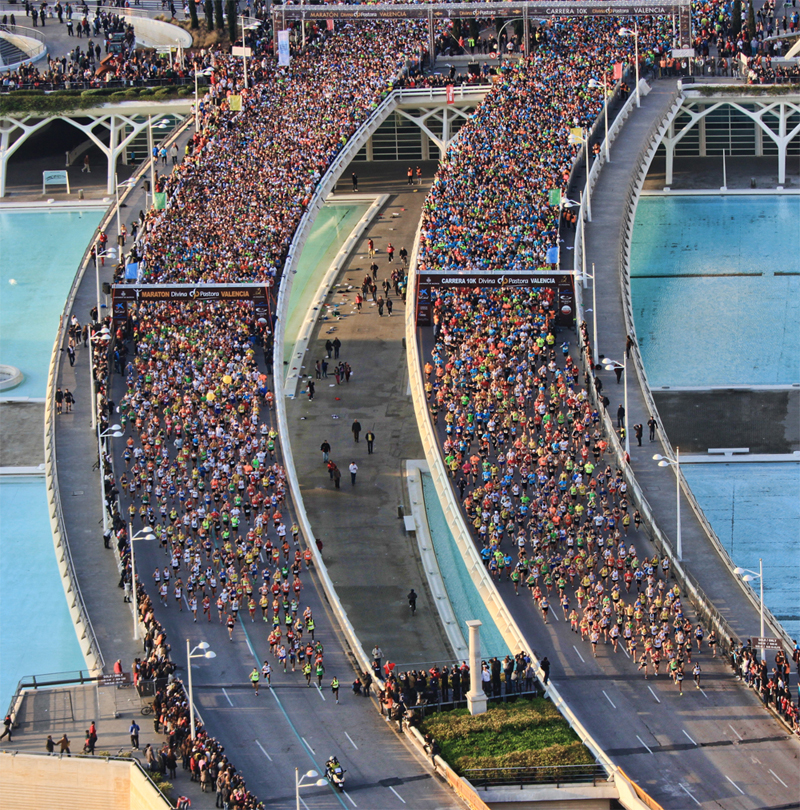
I got up about 3 hours before the 9am start and went down to have breakfast. To pass the time and to put me in the mood before the race, I read Kilian Jornet's book "Run or die" (I'll write a review on this when I finish it, but it hasn't been translated into English yet).
I managed to get a good slot up near the front of the 12,000 or so runners. It's a testament to the organization that I was not at all hindered at any point in the race in spite of there being a 10k race being run in parallel.
However, things didn't bode too well right from the start although, of course I knew there were plenty of kilometers left in which things could take a turn for the better. After only a kilometer I noticed the tendon on the top of my right foot was getting sore - probably related to the pre-race problems I had been having - and it didn't get better during the race. I don't think it had any material impact on my performance though. More seriously, I noticed that my pulse rate was higher than it had been only two weeks ago in Miguelturra, and at a slower pace. The kilometer markers came past at a depressing few seconds slower than the pace at which my Garmin GPS would have me believe I was running at.
I decided to take a slightly risky decision once it was clear that I was running below the necessary pace to beat the 3 hour mark. I allowed myself to run only 2 heart beats per minute faster than I had planned. I remembered that Jonathan had told me that I had some margin in the projected heart rate due to my relatively high anaerobic threshold. This was just enough to be able to cross the halfway mark at 30 seconds over my target of 1:30. I consoled myself by remembering how I had managed to run the second half much faster than the first last year.
The Marathon is a cruel and arrogant master. Just when I thought I was beginning to get it under control, it put me back in my place again, to remind me that anything can happen in a Marathon. I was still running well at the 32km mark where my family were waiting for me (and where the photo in the previous post was taken). But around the 35km mark where a guy was playing the drums next to a banner that said "Knock the wall down", I hit it. Not hard, but that kilometer took me 15 seconds off pace and the next, even more and so on. My pulse rate began to drop and my breathing became more laboured and my legs heavier and heavier. I started pumping my arms more. I ran for some stretches with my eyes closed. I started to get grumpy. A guy bumped into me at one of the water stops and told me not to stop: I angrily replied that I was not stopping. At least that much was true: I didn't stop, not once, and I didn't suffer any cramps. Only 4 or so kilometers before the end, a man rather unwisely decided to cross in front of me on his bike with his small children - who didn't know any better - in tow. I had to bark at them to avoid crashing into them.
As the finish line drew labouriosly closer, I realized that it was at least possible to beat my best time in the Marathon from last year. That was something. I also didn't want my kids to see me shuffling pathetically past. I administered myself an adrenalin injection by shouting obscenities at the Marathon in front of a cheering crowd and was able to surge forward if only for a couple of hundred meters. It was definitely worth it because, apart from being the boost I needed to get a personal best time, it made me feel some emotion even if it was mainly anger and frustration.
As I said in my previous post, I ended up doing the reverse of last year's Marathon: instead of a second half 7 minutes faster than the first, I did a second half 7 minutes slower. My wife asked me if I was disappointed with my time which, after all, was only 7 minutes slower than my target, and a best time at that. I said no, I wasn't, but I was very disappointed to have not been in control. I don't think a race in which you have to run through treacle randomly deposited somewhere along the course would catch on as much of a "fun" idea but this is what the Marathon is unless you can find a way to outsmart "el hombre del mazo" (the sledge hammer man). I wonder if this distance is for me. What I mean by this is - I wonder if I have to go through that frustrating torture of running ever more slowly in order to run to my best (which is a non-negotiable condition that I impose on myself). Or maybe I should just run Marathons well within my pace so as to enjoy them. The thing is, even then I am not sure I wouldn't hit the wall: you burn more or less the same calories per kilometer no matter what pace you run at (within reason). I'd almost be glad to come down with whatever my kids have got - at least then I'd have an explanation and a good reason to try again.
I tend to get a bit discouraged after a disappointment but I quickly bounce back. I'm thinking that you have good days and bad days and part of the art of training is to ensure that the day of the competition is one of those good days: maybe today it just wasn't so, as my slightly elevated pulse seemed to hint at. I think I will try running my next Marathon strictly below the prescribed pulse rate and see what result I get. Or I can avoid hitting the wall that is already an accomplishment; eventually I'll have a "good day" and get below that magic barrier of 3 hours.
Valencia is a wonderful city and it's a shame we didn't get a chance to enjoy it much between the Marathon and the kid's temperature. This afternoon has been a bit stressful with my wife having to rush off to Mali (where 7 people were kidnapped last week, by the way) while we have to wait several hours amongst screaming sickly children in the hospital. Still, the kids are being very good and claim to have enjoyed the weekend in spite of everything.
PS: You can watch my crossing the line (at 3:06:54) here. At least I looked in better shape than the guy being carried over the line in a stretcher.
PPS: I find that you can never put enough vaseline or there is always a bit you forget about. Remind me not to run in those shorts again for a Marathon (they were OK in the Ironman but then you expect to be saddle sore). I'm walking like John Wayne as a result.
Valencia Marathon results
I did the opposite of last year: instead of doing the first half in 1:37 and the second in 1:30, I did the first half in 1:30 and the second half in 1:37. It is a lot more enjoyable doing it the other way round, I can tell you: I hit the wall in kilometer 35 and it was clear that I wasn't going to make my target of sub 3 hours but at least I beat my best time - just, by about 30 seconds.
I'll do a full write up soon.

I'll do a full write up soon.
Sabtu, 26 November 2011
The expo
I've just been to pick up my race number from the expo. The usual stands were there but I was struck by two things. Firstly, the whole minimalist shoe thing was in full swing. In fact, I'd say that there were more minimalist offerings than there were "traditional". I overheard someone on the Merrel stand explaining their line of "barefoot" shoes to which the response was "it looks like you are going back to what we used to run in". There was Vibram, of course, but a stand showing off some "shoes" that looked to me more like brightly colored verruca socks caught my attention. They are made in Spain by a French company called one moment (www.onemoment.es) and are designed as a kind of post-Marathon shoe but have found uses in anything from boating to beach wear. At around 5 euros a go, they look like a great option for wandering down to the start of a Triathlon and, as they are cheap and biodegradable, you don't really care too much about getting them back. Shame they don't make them in my size.
The other trend that caught my attention was the proportion of stands dedicated to Triathlon. Ironman really does seem to be the new Marathon.
Anyway, the runner's goody bag was pretty decent with a nice technical t-shirt, a cap, gels and various back issues of running magazines that I no doubt have read already.
The other trend that caught my attention was the proportion of stands dedicated to Triathlon. Ironman really does seem to be the new Marathon.
Anyway, the runner's goody bag was pretty decent with a nice technical t-shirt, a cap, gels and various back issues of running magazines that I no doubt have read already.
Hace un calor del carajo!
23 degrees! I can't help thinking I should have chosen San Sebastian which is some 7 degrees cooler. Hopefully it won't be too bad in the morning...
The kids have got a temperature so I'm crossing my fingers they don't pass it to me until after the race at least...
The other thing is that my foot is a bit sensitive after a light run of 30 minutes that I did the other day - I've no idea why, but some people have even noticed a slight limp and asked me if I'm ok... I guess that it's the sort I thing I wouldn't even notice normally but that I am hypersensitive this week. It must be nerves...
The kids have got a temperature so I'm crossing my fingers they don't pass it to me until after the race at least...
The other thing is that my foot is a bit sensitive after a light run of 30 minutes that I did the other day - I've no idea why, but some people have even noticed a slight limp and asked me if I'm ok... I guess that it's the sort I thing I wouldn't even notice normally but that I am hypersensitive this week. It must be nerves...
Kamis, 24 November 2011
Maratón de Valencia 2011 (Valencia Marathon 2011)
This will probably be my last post before the Marathon. Haha, how I would like to be able to just find out whether I have been able to break the magic 3 hour barrier just by subscribing to this blog and waiting for the email to arrive! But I have some serious work to do before I can claim the title of a sub 3 hour Marathon man.

The route looks really nice, starting and finishing near the "Arts and Science City" where there are some great museums and a life size "Gulliver", passing alongside the beach before making a scenic tour of the old town center. Our hotel is right by the start (and finish) and the 32 km mark is also very close by, which is a great point for my family to come and cheer me on because I will surely be suffering by then. They should have time to wave to me there before walking the kilometer or so to the finish, well before I get there. The other advantage Valencia Marathon has is that there is a super high speed train from Madrid which really is the best way to travel to and from a Marathon because you can get up and stretch your legs and you don't have all the waiting around you would do in an airport.
So, tune in or subscribe to find out whether I managed to break the 3 hour barrier. I'll post the result as soon as I get my iPhone from the cloakroom after crossing the line... (In the meantime,, you can wish me luck if you like!)

The route looks really nice, starting and finishing near the "Arts and Science City" where there are some great museums and a life size "Gulliver", passing alongside the beach before making a scenic tour of the old town center. Our hotel is right by the start (and finish) and the 32 km mark is also very close by, which is a great point for my family to come and cheer me on because I will surely be suffering by then. They should have time to wave to me there before walking the kilometer or so to the finish, well before I get there. The other advantage Valencia Marathon has is that there is a super high speed train from Madrid which really is the best way to travel to and from a Marathon because you can get up and stretch your legs and you don't have all the waiting around you would do in an airport.
So, tune in or subscribe to find out whether I managed to break the 3 hour barrier. I'll post the result as soon as I get my iPhone from the cloakroom after crossing the line... (In the meantime,, you can wish me luck if you like!)
Rabu, 23 November 2011
Lactate test
Last night was the last test before the Marathon, to confirm that the pace I want to go out at is realistic. In other words, that I am not going to accumulate lactic acid in my muscles. This isn't the only thing that can scupper a Marathon but at least it is something relatively easy to measure.
The test involved running a kilometer round the tartan track at a prescribed pace (I had to make sure I passed the little cones set apart every 100 meters every time my watch beeped) and then my pulse was read and a drop of blood was extracted from my ear to measure the amount of lactate that had accumulated.
I did the first two kilometers in 4:15 (just under sub 3 hour Marathon pace) and the last two in 4:00. My pulse rate for the first two was 155 at the end and, for the second two, was 166. I have to wait to hear the verdict from the lactate analysis, but it looked like it was very low (and constant, i.e., not accumulating) at the pace of 4:15. (I just got the results: 1.7 mmol at 4:15 per km and 2.9 mmol at 4:00 per km. As expected, my pace should be somewhere between the two but closer to 4:15. Here is a good article on the subject.)
My coach was there and said that the question wasn't whether to go at sub 3 hour pace but rather to risk going for an even faster time. Unless the results say otherwise I aim to stick to the plan I laid out recently: run to the pulse rate set out by Jonathan, at which I have never blown up (touch wood) and, at which, I have achieved several personal best times.
The test involved running a kilometer round the tartan track at a prescribed pace (I had to make sure I passed the little cones set apart every 100 meters every time my watch beeped) and then my pulse was read and a drop of blood was extracted from my ear to measure the amount of lactate that had accumulated.
I did the first two kilometers in 4:15 (just under sub 3 hour Marathon pace) and the last two in 4:00. My pulse rate for the first two was 155 at the end and, for the second two, was 166. I have to wait to hear the verdict from the lactate analysis, but it looked like it was very low (and constant, i.e., not accumulating) at the pace of 4:15. (I just got the results: 1.7 mmol at 4:15 per km and 2.9 mmol at 4:00 per km. As expected, my pace should be somewhere between the two but closer to 4:15. Here is a good article on the subject.)
My coach was there and said that the question wasn't whether to go at sub 3 hour pace but rather to risk going for an even faster time. Unless the results say otherwise I aim to stick to the plan I laid out recently: run to the pulse rate set out by Jonathan, at which I have never blown up (touch wood) and, at which, I have achieved several personal best times.
Senin, 21 November 2011
Marathon plan
Less than a week to go... All that's left is
Monday: Rest.
Tuesday: Lactate test at Marathon pace.
Wednesday: 40 minute easy run
Thursday: 30 minute easy run. Massage. Start carboloading (850g of carbohydrates a day). Cut toenails!
Friday: Rest. Carboload.
Saturday: 20 minute easy run. Carboload.
Sunday: Marathon.
For the race itself, I have printed of this little cheat-sheet to stick on my watch:
 In other words, I'll keep my pulse below 164 for the first half and then allow my pulse to drift up to 173 by the end. To check whether I am on pace for the magic sub 3 hours time, I've worked out the times I need to pass each 5km marker. I anticipate having to run the first half at a split of 4:13 per kilometer, allowing me to slow down to a 4:18 split for the second half. I think it is too much to hope for a "negative split" (second half faster than first half) at this kind of pace. This time I am going to go by the official markers and not what the Garmin says. After all, a Marathon aint over until you cross the finish line, even if your GPS reckons you've already covered the 42.2km.
Every 5 kilometers I'll take a salt tablet. I'll carry with me in my Fuel Belt two 8oz flasks full of High5 Isogel (which can be taken without water but I'll drink water at every station). I can carry about 9 of them which works out at a rate of 3 every hour, or about 264 calories per hour. Together with the 3 day carboloading, I hope to avoid hitting the dreaded wall like I managed to do last year.
And that's more or less it. I'll think about running technique as much as I can, focusing on good rhythm, good cadence, engaging the core, not overstriding etc. In particular, my running cues will be:
- to extend the hips (or "punching it forwards" as I call it)
- to get my legs up under me ("sitting down on the job")
- to lean from my ankles ("run tall")
- to pick up the ground quickly ("sharp catch")
I'll also make sure I am in a good pack, protected from the wind. I'll let myself become hypnotized by the side to side bobbing of the head of the runner in front of me. I will not be scared of the Marathon but I will respect it.
Monday: Rest.
Tuesday: Lactate test at Marathon pace.
Wednesday: 40 minute easy run
Thursday: 30 minute easy run. Massage. Start carboloading (850g of carbohydrates a day). Cut toenails!
Friday: Rest. Carboload.
Saturday: 20 minute easy run. Carboload.
Sunday: Marathon.
For the race itself, I have printed of this little cheat-sheet to stick on my watch:
Every 5 kilometers I'll take a salt tablet. I'll carry with me in my Fuel Belt two 8oz flasks full of High5 Isogel (which can be taken without water but I'll drink water at every station). I can carry about 9 of them which works out at a rate of 3 every hour, or about 264 calories per hour. Together with the 3 day carboloading, I hope to avoid hitting the dreaded wall like I managed to do last year.
And that's more or less it. I'll think about running technique as much as I can, focusing on good rhythm, good cadence, engaging the core, not overstriding etc. In particular, my running cues will be:
- to extend the hips (or "punching it forwards" as I call it)
- to get my legs up under me ("sitting down on the job")
- to lean from my ankles ("run tall")
- to pick up the ground quickly ("sharp catch")
I'll also make sure I am in a good pack, protected from the wind. I'll let myself become hypnotized by the side to side bobbing of the head of the runner in front of me. I will not be scared of the Marathon but I will respect it.
The rain in Spain...
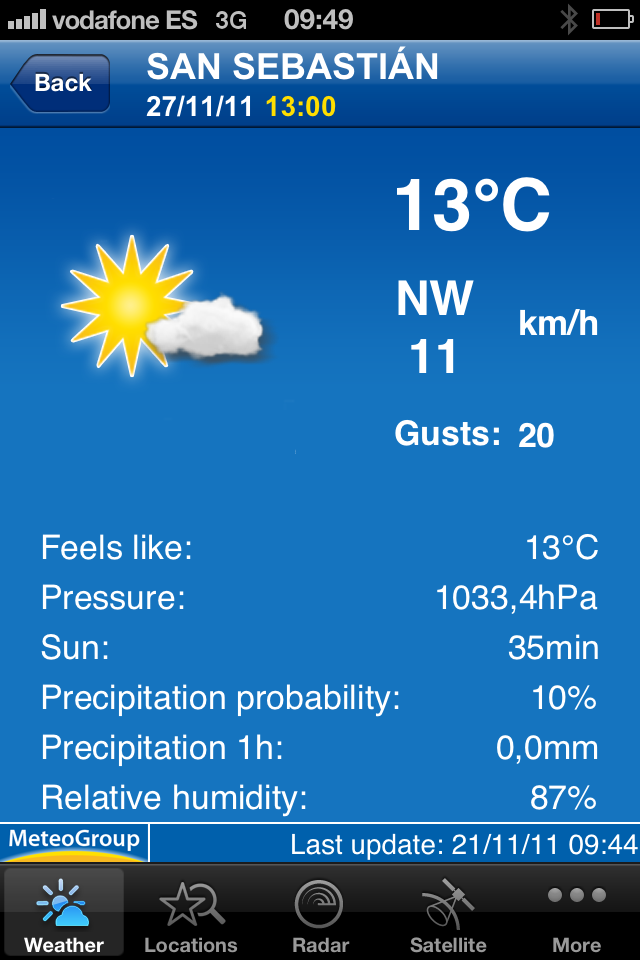


There are two major Marathons in Spain next Sunday: one in San Sebastian (which I did last year) and one in Valencia (which I am doing this year). Actually, the Valencia Marathon should have been yesterday but it would have coincided with the national elections and so they decided some time ago to postpone it by one week. This is the weather forecast one week out, so its probably not very reliable, but it looks like Valencia will be warmer but with less humidity and less wind. That sounds like the better deal to me even though, as far as I am concerned, the colder the better, even a bit of rain is welcome. In any case, I hope to be well past the finish line by 1pm as the Marathon starts at 9am.
Kamis, 17 November 2011
It's all downhill from here...
So I did the LHWBTM last night (the Last Hard Workout Before The Marathon): two lots of 8km at close to anaerobic pace (15.5-16.0kph) on the treadmill, with the fan on full blast and Saw II playing in the background to distract me from my own suffering. After each bout I went out into the garden to cool off - there was so much steam rising from my body it was like putting my face over a boiling kettle. About halfway through the second set, the brilliant idea of stopping occurred to me - usually when this happens, I enter into a conversation with myself rather like the one I described in this post - but this time I managed to shut myself up and struggle on to end. Even though I ended up both times with my heart rate around 177-181 (which is where my anaerobic threshold was last time I had it measured), it didn't feel too hard. Let me qualify that. I mean that my legs didn't feel tired and my breathing was not overly laboured. So why did I want to stop after only 15 minutes? The reason is that I get so hot that it becomes stifling.
I did a fairly heavy weights session on Tuesday (75% of maximum) - in fact, as I was cooling down on the spinning bike, the instructor came over to congratulate me on how much I was squatting (120kg + 15kg bar). I also have another weights session today (60%). A couple of weeks ago a friend of mine who is also running the Marathon in Valencia (somewhat faster than me) was surprised that I was still doing weights even back then, so close to the Marathon. On the other hand it makes a lot of sense to me, as long as you are careful not to lift above your ability. I followed a protocol set out by my trainer in order to determine my maximums - how much can I lift only once before failure. The idea is to estimate this without actually provoking failure, which can lead to injury. The point about the taper is to reduce the training load so as to allow your body to recover and adapt, and to restore your energy (glycogen) levels. On the other hand, doing weights is a very important aspect of Marathon training, and one that doesn't burn much energy. As you get tired in a Marathon, your muscle fibres fatigue and new fibres (and other muscle groups) start to get recruited. The only times that these "secondary" muscle fibres get put through their paces is when you do a long run, when you run on tired legs or when you do weights. Gadgets like vibrating platforms and electrostimulators promise to recruit 100% of your muscle fibres but I've yet to be convinced that they are as effective.
All that's left to do between now and the Marathon are a few short, easy runs, just to keep things ticking over and a lactate test (more on this soon) to help establish a pacing plan.
I did a fairly heavy weights session on Tuesday (75% of maximum) - in fact, as I was cooling down on the spinning bike, the instructor came over to congratulate me on how much I was squatting (120kg + 15kg bar). I also have another weights session today (60%). A couple of weeks ago a friend of mine who is also running the Marathon in Valencia (somewhat faster than me) was surprised that I was still doing weights even back then, so close to the Marathon. On the other hand it makes a lot of sense to me, as long as you are careful not to lift above your ability. I followed a protocol set out by my trainer in order to determine my maximums - how much can I lift only once before failure. The idea is to estimate this without actually provoking failure, which can lead to injury. The point about the taper is to reduce the training load so as to allow your body to recover and adapt, and to restore your energy (glycogen) levels. On the other hand, doing weights is a very important aspect of Marathon training, and one that doesn't burn much energy. As you get tired in a Marathon, your muscle fibres fatigue and new fibres (and other muscle groups) start to get recruited. The only times that these "secondary" muscle fibres get put through their paces is when you do a long run, when you run on tired legs or when you do weights. Gadgets like vibrating platforms and electrostimulators promise to recruit 100% of your muscle fibres but I've yet to be convinced that they are as effective.
All that's left to do between now and the Marathon are a few short, easy runs, just to keep things ticking over and a lactate test (more on this soon) to help establish a pacing plan.
Senin, 14 November 2011
Media Maratón de Miguelturra (Half Marathon)

I think these graphs comparing the Half Marathon yesterday with the first half of the San Sebastian Marathon I did a year ago (in a time of 3:07) speak for themselves:

I couldn't help getting a little carried away for the last kilometer - it was just too exciting and, even though I consciously refrained from a finishing sprint, I ended up with a sub 4:00 last split. Around kilometer 13 was when we hit the headwind and I decided to sprint to catch up with my group again - it also corresponds to the little hump in my pulse rate.
Jumat, 11 November 2011
New York, New York
It's just as well that I've tried three times to get in to the New York Marathon via the lottery scheme and failed because the rules are changing and soon it will no longer be a case of "three strikes and you are in". Also, the qualifying times are becoming much more demanding:

The 40-44 male age group, randomly chosen from the one I'll be in as of next year jumps from 3:10 to 2:50! On the other hand, the corresponding Half Marathon qualifying time is 1:23 which is a time I have already beaten myself (although, admittedly, at the spritely age of 39). According to Jack Daniels, the legendary running coach and author of "The Daniels Running Formula" (as opposed to the legendary Bourbon whiskey), a time of 1:23 equates to a Marathon time of 2:54. If anything I would expect the Half Marathon qualifying time to be even more stringent but I'm not complaining because it may well be my only ticket to guaranteed entry after 2012. The qualifiying times for the other age groups are very close to the predictions made by the formula which is interesting, given that they are supposedly based on a 75% percentile. Personally, I find it hard to believe that if I were to run the New York Marathon in 2 hours and 50 minutes I would only be in the top 25%. In fact, looking at the results from this year's New York Marathon, the guy who came in just under 2:50 finished in 61st place in his age group, out of 5,884 runners in the same age group who finished the race. Maybe the "75%" is based on the times that people hope to achieve, rather than the times they actually achieve.
So it looks like the New York Marathon is trying to knock the Boston Marathon off its pedestal, as the race that many amateur runners aspire to qualify for. People talk about getting a "BQ" - Boston Qualifier - more than they talk about getting a "PB" - Personal Best. Boston is to Marathons as Kona is to the Ironman (although I do think that it is a lot easier, relatively speaking, to qualify for Boston). The qualifying times for Boston are as follows, although it should be noted that they are not guaranteed: instead, slots are opened up first to those that have a qualifying time more than 20 minutes faster than the cutoff and then those who are 10 minutes faster, etc.
So, as you can see, in the 40-44 male age group, for example, the qualifying time for Boston is 25 minutes slower than the qualifying time for the New York Marathon. The difference is that there is no lottery system in Boston so, other than a limited number of people who gain access through specialized running travel agencies (paying lot's of money), the qualifying times apply to everyone. Ironically, a "BQ" time no longer guarantees entry to the Boston Marathon while the much more demanding "NYQ" time does at least guarantee entry to the New York Marathon.

The 40-44 male age group, randomly chosen from the one I'll be in as of next year jumps from 3:10 to 2:50! On the other hand, the corresponding Half Marathon qualifying time is 1:23 which is a time I have already beaten myself (although, admittedly, at the spritely age of 39). According to Jack Daniels, the legendary running coach and author of "The Daniels Running Formula" (as opposed to the legendary Bourbon whiskey), a time of 1:23 equates to a Marathon time of 2:54. If anything I would expect the Half Marathon qualifying time to be even more stringent but I'm not complaining because it may well be my only ticket to guaranteed entry after 2012. The qualifiying times for the other age groups are very close to the predictions made by the formula which is interesting, given that they are supposedly based on a 75% percentile. Personally, I find it hard to believe that if I were to run the New York Marathon in 2 hours and 50 minutes I would only be in the top 25%. In fact, looking at the results from this year's New York Marathon, the guy who came in just under 2:50 finished in 61st place in his age group, out of 5,884 runners in the same age group who finished the race. Maybe the "75%" is based on the times that people hope to achieve, rather than the times they actually achieve.
So it looks like the New York Marathon is trying to knock the Boston Marathon off its pedestal, as the race that many amateur runners aspire to qualify for. People talk about getting a "BQ" - Boston Qualifier - more than they talk about getting a "PB" - Personal Best. Boston is to Marathons as Kona is to the Ironman (although I do think that it is a lot easier, relatively speaking, to qualify for Boston). The qualifying times for Boston are as follows, although it should be noted that they are not guaranteed: instead, slots are opened up first to those that have a qualifying time more than 20 minutes faster than the cutoff and then those who are 10 minutes faster, etc.
2013 Qualifying Times (effective September 24, 2011)
| Age Group | Men | Women |
|---|---|---|
| 18-34 | 3hrs 05min 00sec | 3hrs 35min 00sec |
| 35-39 | 3hrs 10min 00sec | 3hrs 40min 00sec |
| 40-44 | 3hrs 15min 00sec | 3hrs 45min 00sec |
| 45-49 | 3hrs 25min 00sec | 3hrs 55min 00sec |
| 50-54 | 3hrs 30min 00sec | 4hrs 00min 00sec |
| 55-59 | 3hrs 40min 00sec | 4hrs 10min 00sec |
| 60-64 | 3hrs 55min 00sec | 4hrs 25min 00sec |
| 65-69 | 4hrs 10min 00sec | 4hrs 40min 00sec |
| 70-74 | 4hrs 25min 00sec | 4hrs 55min 00sec |
| 75-79 | 4hrs 40min 00sec | 5hrs 10min 00sec |
| 80 and over | 4hrs 55min 00sec | 5hrs 25min 00sec |
| Unlike previous years, an additional 59 seconds will NOT be accepted for each age group time standard. | ||
So, as you can see, in the 40-44 male age group, for example, the qualifying time for Boston is 25 minutes slower than the qualifying time for the New York Marathon. The difference is that there is no lottery system in Boston so, other than a limited number of people who gain access through specialized running travel agencies (paying lot's of money), the qualifying times apply to everyone. Ironically, a "BQ" time no longer guarantees entry to the Boston Marathon while the much more demanding "NYQ" time does at least guarantee entry to the New York Marathon.
Selasa, 09 Agustus 2011
2:59:59
 |
| I borrowed this photo from here. The guy on the right must have felt very pleased with himself aftterwards |
The three hour mark in the Marathon happens to be a bit of a Holy Grail for many amateur runners. It's quite fast but by no means elite level. I have one friend who has been oh-so-close to breaking it - for example, in Seville he stopped to argue with a police car that crossed in front of him (later the policeman paid him a visit at his house after looking up his race number!) and ended up finishing in 3:00:12.
Yesterday I read an interesting article in Lava magazine, which was based on interviews with the male and female Ironman World record holders (although, if you include Challenge Roth, this record was beaten a week later): Marino Vanhoenacker and Chrissie Wellington. In it, they both say that "age groupers" (the commonly accepted euphemism for non-professional triathlete) shouldn't obsess with results and should remember to enjoy it. Chrissie put it like this: "I see people cross the finish line and the first thing they do is look down at their watch. Stop it! Get an awesome finish line photo and bank that memory. The timing chip can sort the rest out later.” On the one hand it's tempting to say, "It's alright for you to say that - you are the fastest in the World, ever!" but it's also true that she has a good point. I've said before that one of the things I like about the Ironman distance is that you really can't compare one race to another, not even from one year to another over the same course.
I think that there is something to be said for trying to get a personal best time. In Spanish there is a word which is hard to translate into English - "superación" - it means the act of trying to better oneself. That I think is a very laudable goal - the mistake is to convert it into numbers. Just to know that you have done your best and that you have experienced or learned something new is "superación" enough.
Senin, 11 Juli 2011
I'm back with a vengeance!
I'd thought that I would just leave my blog there - after all, mission accomplished, I'm now an Ironman - but, of course, it never ends there, or anywhere. Once I met a guy who was reported to have been awarded the biggest trading bonus ever paid in the City - 35 million pounds - and the obvious question came to mind: "Why does he keep working?" The answer is obvious and it is that, if you are driven enough to achieve something, once you have achieved it, your drive doesn't just go away overnight.
Lately I've been gorging myself on books written by Ultrarunners - people who regularly run distances of 100 miles or more - like "Running on Empty" by Marshall Ulrich, which tells of his feat of running across America (3,000 miles) in 57 days. As I often say, my goals seem to define me more than I am able to define my goals... So I have this uncanny feeling that this challenge of running an Ultramarathon is slowly creeping up on me and that, one day, I will just wake up absolutely determined to complete one. For the time being, I am really hoping that I can stave it off because I don't think my wife will be too happy: Ultramarathons tend to be very extreme events, not just in distance but in conditions. About the Ironnman, she told me quite plainly that "if I wanted to do another, it would be with another"... In the context of this blog, that paints a slightly unfair picture of her. Doing the Ironman put an enormous strain on her and I am very grateful to her for the patience and suffering she put up with to help me achieve a personal goal that she could only distantly relate to. If, on top of that, it seems like a dangerous pursuit, then it will be hard to convince her of the validity of the goal. I'd hope that training for an Ultradistance event would at least be less time consuming - just think, if I were to spend those 25 hours a week I trained for the Ironman just running, I would be covering well over 250 kilometers, the sort of distance only the top Marathon runners in the World might be clocking up. On the other hand, to compare Ultramarathoners to Marathoners seems to be like comparing hippies to soldiers. The Ultramarathon scene is very different to any other from what I can gather. Above all there is much more camaraderie as most people are concerned more with completing the distance than being first to cross the line. There is something so enticing about watching someone like Anton Krupicka, one of the best Ultrarunners in the World, running across his trails:

Which reminds me, I'm getting ahead of myself: I've spent the last month and a half in what I've been calling my "Forrest Gump" phase. I asked my trainer for a sabbatical and he said "Fine, as long as you keep on weight training in the meantime". The irony is that he programmed me so much weight training that it didn't really feel like much of a break from structured training. Even so, I've been avoiding as much as is possible training for the sake of training - that is to say, I try to actually get somewhere by running or cycling rather than going on random out-and-back jaunts. I've been running to work a lot more frequently - that's 25 kilometers in total just there - but the Powers That Be have suddenly and arbitrarily decided that employees are not allowed to cycle on campus. This puts a serious spanner in the works because it means that I have to get from the gym to my office using the internal (infernal?) buses, thus adding back all the time I saved combining running and getting to work in the first place. I'm fighting this one at the highest echelons of the company so I hope that it will be a short lived dogma.
I've enjoyed running without a heart rate monitor, not worrying whether I'm running too slow or too fast, just listening to the sound of my own breathing and the tap-tap of my feet, or my iPod which I have been using a lot more lately. I managed to build up to running almost 100 kilometers last week, which isn't bad while still being a long way off Forrest Gump territory. I haven't been worrying too much about what I eat (or drink, for that matter) either and, as a consequence have put on about 5 kilos since the Ironman. I'm not bothered about that at all, I've got plenty of time to burn it off and I'm not even sure that it isn't due to the increased weight training I have been doing, rather than the lax diet. But it hasn't been completely without wrinkles. For some reason (er, hello? increased mileage!) the torn meniscus in my knee has been acting up. It doesn't hurt when I am running at all, although I do notice it clicking slightly when I run up hill. The problem is that when I am walking it gets a bit irritating. I'm hoping it will calm down in a week or two. I've also been having some problems with blisters (which, by the way, are the bane of Ultrarunners). It's been the result of me mucking around changing shoes and trying to find the perfect minimalist trail shoe (verdict: Vivobarefoot Evo) and minimalist race shoe (verdict: Vivobarefoot Ultra). Everything was going fine until I decided to watch one of the most tedious films I have ever seen in my life - Ironman 2 - and I couldn't help but entertain myself by picking at the dead skin (and some bits that were still quite alive) on my foot. As a former smoker and nail biter, there is something exquisitely addictive about peeling off dead skin: I go into an almost trance-like state and can't stop until the pain brings me to my senses.
Probably the best thing about the last 6 weeks has been my coming to terms with the Ironman. As you will have realized from reading in between the lines of my race report, I was somewhat disappointed with the experience of the race itself, having any attempt to grit my teeth and force out a best performance frustrated by muscle fatigue and having expected to have been overcome by emotion on crossing the finish line. It particularly sticks in my mind the comment of one of my work colleagues after I explained this to him. He said that I had very little "self love" or, in other words, I was too hard on myself. The problem I find with competitions which are so extreme that just finishing them is an achievement in its own right, is that you train and train precisely so that it doesn't seem like a "big deal" anymore. This is where the need to go further and further comes in - and I really want to avoid falling into that trap! During the first few weeks after the Ironmman I suffered the Post-Ironman Blues as can be expected: I suddenly felt aimless, like a rebel without a cause. The weekends did seem incredibly long though, now that I wasn't spending most of them out on the bike. What has started to happen is that I have begun to realize what an achievement it was, finishing an Ironman. Now I can barely contemplate the amount of training I was doing only a few months ago. Now it really does seem impressive and finally I am starting to feel proud of being an Ironman. Are my children at least proud that their dad is an Ironman? I don't think they can really understand what the distances mean, even though I have recently started running one or two kilometers with them (at quite a clip!). Luca (the eldest) still always brings up the time when I came second in a 5k race at work as my crowning accomplishment. By the way, I chickened out of getting a tattoo done but instead opted for something just as permanent but with the advantage that I can take it off: a ring with the magical distance of 140.6 miles emblazoned into it, to remind me that I can do anything I put my mind to.

I've decided it's time to get back to work. Jonathan has just sent me my training programme and tomorrow, for example, I have to run 7 series of 3 minutes at above my anaerobic threshold (around 16kph should do the trick) while wearing a weighted flak jacket. I think that will be the fastest I have run all year. I suppose it will be a shock to the system at first, but I am looking forward to doing some speed work again. I recently read that one of the reasons to include high intensity training in the preparation for a Marathon is that you train your fast twitch fibres which get recruited late on in the race as the slow twitch fibres fatigue. It's no good if you have neglected them all season for them to be put to test at the end of a Marathon. I wonder if this was something I should have done in preparation for the Ironman (I did do high intensity work on the bike but not running) - perhaps then I wouldn't have suffered so much from muscle fatigue at the end of the race, who knows. On the other hand, this can interfere with the body's fat burning capabilities - it's all quite a delicate balancing act.
By the way, I was flicking through a Brazilian Triathlon magazine last week, one with coverage of the Ironman in Brazil, when I was shocked to see that, out of all the 1,800 athletes competing, they chose a picture of me!! It's actually an article about whether or not to use a disc wheel - which is ironic because my wheel was actually a normal wheel with a plastic cover, but I suppose the same principles apply.

So what's next? Well, the next goal is to try to break the elusive 3 hour barrier in the Marathon. I've signed up for the Marathon in Valencia on the 20th of November. It's rather like the one I did in San Sebastian - flat, sea level, cool but humid and with potentially strong winds. I think I have a chance to break 3 hours if everything goes well because
a) The Marathon I did in San Sebastian (only the second Marathon I have run) I did in a time of 3:07 with a huge negative split (when you run the first half more slowly than the second half) of 7 minutes.
b) All the aerobic base training I did for the Ironman should stand me in good stead.
c) My best time in the Half Marathon is 1:23 which, according to those tables that equate performances across distances, is equivalent to a sub 3 hour Marathon. (Of course this doesn't really mean anything except that it isn't an unrealistic goal.)
d) If I felt denied my teeth gritting moment in the Ironman, then with some luck I will have it in the Marathon instead.
e) This will be the 4th Marathon I've run (if you include the Ironman Marathon) so I have some experience to draw on.
f) I'll be running in my super-lightweight Vivobbarefoot Ultras!
So I invite you to follow me on the next part of my journey to
BREAK 3 HOURS IN THE MARATHON!
Lately I've been gorging myself on books written by Ultrarunners - people who regularly run distances of 100 miles or more - like "Running on Empty" by Marshall Ulrich, which tells of his feat of running across America (3,000 miles) in 57 days. As I often say, my goals seem to define me more than I am able to define my goals... So I have this uncanny feeling that this challenge of running an Ultramarathon is slowly creeping up on me and that, one day, I will just wake up absolutely determined to complete one. For the time being, I am really hoping that I can stave it off because I don't think my wife will be too happy: Ultramarathons tend to be very extreme events, not just in distance but in conditions. About the Ironnman, she told me quite plainly that "if I wanted to do another, it would be with another"... In the context of this blog, that paints a slightly unfair picture of her. Doing the Ironman put an enormous strain on her and I am very grateful to her for the patience and suffering she put up with to help me achieve a personal goal that she could only distantly relate to. If, on top of that, it seems like a dangerous pursuit, then it will be hard to convince her of the validity of the goal. I'd hope that training for an Ultradistance event would at least be less time consuming - just think, if I were to spend those 25 hours a week I trained for the Ironman just running, I would be covering well over 250 kilometers, the sort of distance only the top Marathon runners in the World might be clocking up. On the other hand, to compare Ultramarathoners to Marathoners seems to be like comparing hippies to soldiers. The Ultramarathon scene is very different to any other from what I can gather. Above all there is much more camaraderie as most people are concerned more with completing the distance than being first to cross the line. There is something so enticing about watching someone like Anton Krupicka, one of the best Ultrarunners in the World, running across his trails:

Which reminds me, I'm getting ahead of myself: I've spent the last month and a half in what I've been calling my "Forrest Gump" phase. I asked my trainer for a sabbatical and he said "Fine, as long as you keep on weight training in the meantime". The irony is that he programmed me so much weight training that it didn't really feel like much of a break from structured training. Even so, I've been avoiding as much as is possible training for the sake of training - that is to say, I try to actually get somewhere by running or cycling rather than going on random out-and-back jaunts. I've been running to work a lot more frequently - that's 25 kilometers in total just there - but the Powers That Be have suddenly and arbitrarily decided that employees are not allowed to cycle on campus. This puts a serious spanner in the works because it means that I have to get from the gym to my office using the internal (infernal?) buses, thus adding back all the time I saved combining running and getting to work in the first place. I'm fighting this one at the highest echelons of the company so I hope that it will be a short lived dogma.
I've enjoyed running without a heart rate monitor, not worrying whether I'm running too slow or too fast, just listening to the sound of my own breathing and the tap-tap of my feet, or my iPod which I have been using a lot more lately. I managed to build up to running almost 100 kilometers last week, which isn't bad while still being a long way off Forrest Gump territory. I haven't been worrying too much about what I eat (or drink, for that matter) either and, as a consequence have put on about 5 kilos since the Ironman. I'm not bothered about that at all, I've got plenty of time to burn it off and I'm not even sure that it isn't due to the increased weight training I have been doing, rather than the lax diet. But it hasn't been completely without wrinkles. For some reason (er, hello? increased mileage!) the torn meniscus in my knee has been acting up. It doesn't hurt when I am running at all, although I do notice it clicking slightly when I run up hill. The problem is that when I am walking it gets a bit irritating. I'm hoping it will calm down in a week or two. I've also been having some problems with blisters (which, by the way, are the bane of Ultrarunners). It's been the result of me mucking around changing shoes and trying to find the perfect minimalist trail shoe (verdict: Vivobarefoot Evo) and minimalist race shoe (verdict: Vivobarefoot Ultra). Everything was going fine until I decided to watch one of the most tedious films I have ever seen in my life - Ironman 2 - and I couldn't help but entertain myself by picking at the dead skin (and some bits that were still quite alive) on my foot. As a former smoker and nail biter, there is something exquisitely addictive about peeling off dead skin: I go into an almost trance-like state and can't stop until the pain brings me to my senses.
Probably the best thing about the last 6 weeks has been my coming to terms with the Ironman. As you will have realized from reading in between the lines of my race report, I was somewhat disappointed with the experience of the race itself, having any attempt to grit my teeth and force out a best performance frustrated by muscle fatigue and having expected to have been overcome by emotion on crossing the finish line. It particularly sticks in my mind the comment of one of my work colleagues after I explained this to him. He said that I had very little "self love" or, in other words, I was too hard on myself. The problem I find with competitions which are so extreme that just finishing them is an achievement in its own right, is that you train and train precisely so that it doesn't seem like a "big deal" anymore. This is where the need to go further and further comes in - and I really want to avoid falling into that trap! During the first few weeks after the Ironmman I suffered the Post-Ironman Blues as can be expected: I suddenly felt aimless, like a rebel without a cause. The weekends did seem incredibly long though, now that I wasn't spending most of them out on the bike. What has started to happen is that I have begun to realize what an achievement it was, finishing an Ironman. Now I can barely contemplate the amount of training I was doing only a few months ago. Now it really does seem impressive and finally I am starting to feel proud of being an Ironman. Are my children at least proud that their dad is an Ironman? I don't think they can really understand what the distances mean, even though I have recently started running one or two kilometers with them (at quite a clip!). Luca (the eldest) still always brings up the time when I came second in a 5k race at work as my crowning accomplishment. By the way, I chickened out of getting a tattoo done but instead opted for something just as permanent but with the advantage that I can take it off: a ring with the magical distance of 140.6 miles emblazoned into it, to remind me that I can do anything I put my mind to.

I've decided it's time to get back to work. Jonathan has just sent me my training programme and tomorrow, for example, I have to run 7 series of 3 minutes at above my anaerobic threshold (around 16kph should do the trick) while wearing a weighted flak jacket. I think that will be the fastest I have run all year. I suppose it will be a shock to the system at first, but I am looking forward to doing some speed work again. I recently read that one of the reasons to include high intensity training in the preparation for a Marathon is that you train your fast twitch fibres which get recruited late on in the race as the slow twitch fibres fatigue. It's no good if you have neglected them all season for them to be put to test at the end of a Marathon. I wonder if this was something I should have done in preparation for the Ironman (I did do high intensity work on the bike but not running) - perhaps then I wouldn't have suffered so much from muscle fatigue at the end of the race, who knows. On the other hand, this can interfere with the body's fat burning capabilities - it's all quite a delicate balancing act.
By the way, I was flicking through a Brazilian Triathlon magazine last week, one with coverage of the Ironman in Brazil, when I was shocked to see that, out of all the 1,800 athletes competing, they chose a picture of me!! It's actually an article about whether or not to use a disc wheel - which is ironic because my wheel was actually a normal wheel with a plastic cover, but I suppose the same principles apply.

So what's next? Well, the next goal is to try to break the elusive 3 hour barrier in the Marathon. I've signed up for the Marathon in Valencia on the 20th of November. It's rather like the one I did in San Sebastian - flat, sea level, cool but humid and with potentially strong winds. I think I have a chance to break 3 hours if everything goes well because
a) The Marathon I did in San Sebastian (only the second Marathon I have run) I did in a time of 3:07 with a huge negative split (when you run the first half more slowly than the second half) of 7 minutes.
b) All the aerobic base training I did for the Ironman should stand me in good stead.
c) My best time in the Half Marathon is 1:23 which, according to those tables that equate performances across distances, is equivalent to a sub 3 hour Marathon. (Of course this doesn't really mean anything except that it isn't an unrealistic goal.)
d) If I felt denied my teeth gritting moment in the Ironman, then with some luck I will have it in the Marathon instead.
e) This will be the 4th Marathon I've run (if you include the Ironman Marathon) so I have some experience to draw on.
f) I'll be running in my super-lightweight Vivobbarefoot Ultras!
So I invite you to follow me on the next part of my journey to
BREAK 3 HOURS IN THE MARATHON!
Senin, 16 Mei 2011
Fuckfuckfuck
I just read that Sammy Wanjiru, the reigning Olympic champion in the Marathon and former Half Marathon World Record holder has just died, aged 24. He was someone to watch! At 24 to be one of the best Marathoners in the World, imagine what we could have had to look forward to when he was a bit older. Apparently he died in a fall (or possibly jump) from a balcony in Kenya. Sad, sad news indeed.

Although I suppose it is too soon to know for sure, according to the Telegraph, he had an argument with his wife after she found him in bed with another woman (oh dear) and he jumped out of the window in a rage. Apparently they had quite a stormy relationship - he was charged back in December for attempting to murder her and for illegal possession of an AK-47 rifle.

Although I suppose it is too soon to know for sure, according to the Telegraph, he had an argument with his wife after she found him in bed with another woman (oh dear) and he jumped out of the window in a rage. Apparently they had quite a stormy relationship - he was charged back in December for attempting to murder her and for illegal possession of an AK-47 rifle.
Jumat, 06 Mei 2011
What next?
You'd be right in thinking: Hang on, did I miss something? He hasn't actually done the Ironman yet so how can he be talking about what comes next?
Well, I am all too aware of the anticlimax and, after having spent a year thinking about almost nothing else, it is going to be a big one. So I need to have something to fix my mind on before I cross that line. My goals have a tendency to determine me, rather than the other way round so I'd better chose something less ambitious than the Ironman before some other crazy idea gets in my head.
I'd like to do a winter Marathon again this year - I'm thinking of doing the one on the 6th December in Málaga, close to where my parents live. It'd be nice to be able to have them cheering me on, as they used to all those years ago in my rowing days. I'd like to capitalize on all this aerobic training I've been doing and see if I can break that magical 3 hour barrier.

I'm also thinking of trying Stand-Up Paddling (SUP). When we were in Asturias recently, I saw someone doing it. It looks a bit like a modern version of punting (I was born in Cambridge and studied in Oxford, so I've done more than the average amount of punting in my life). It grew up out of Hawaii, apparently, so that explains why so many Ironman triathletes seem to be taking it up (Eneko Llanos, Craig Alexander, ...). It also looks like a damn good workout for your core muscles. I don't really believe in fate, but when several things all seem to be pointing in the same direction, I start to pay attention. So when I discovered that the Asturian center for SUP surfing is based on the beach nearest where we stay in a hut that I have run past numerous times, I thought that it's time for me to try it out. Next time we go to Asturias, I'll sign up for a course.
Well, I am all too aware of the anticlimax and, after having spent a year thinking about almost nothing else, it is going to be a big one. So I need to have something to fix my mind on before I cross that line. My goals have a tendency to determine me, rather than the other way round so I'd better chose something less ambitious than the Ironman before some other crazy idea gets in my head.
I'd like to do a winter Marathon again this year - I'm thinking of doing the one on the 6th December in Málaga, close to where my parents live. It'd be nice to be able to have them cheering me on, as they used to all those years ago in my rowing days. I'd like to capitalize on all this aerobic training I've been doing and see if I can break that magical 3 hour barrier.

I'm also thinking of trying Stand-Up Paddling (SUP). When we were in Asturias recently, I saw someone doing it. It looks a bit like a modern version of punting (I was born in Cambridge and studied in Oxford, so I've done more than the average amount of punting in my life). It grew up out of Hawaii, apparently, so that explains why so many Ironman triathletes seem to be taking it up (Eneko Llanos, Craig Alexander, ...). It also looks like a damn good workout for your core muscles. I don't really believe in fate, but when several things all seem to be pointing in the same direction, I start to pay attention. So when I discovered that the Asturian center for SUP surfing is based on the beach nearest where we stay in a hut that I have run past numerous times, I thought that it's time for me to try it out. Next time we go to Asturias, I'll sign up for a course.
Rabu, 20 April 2011
Boston Marathon

The 2011 Boston Marathon was at the weekend and it sounds as though it must have been incredible. No less than two (Kenyans obviously) ran the course under the World record time of 2:03:59 and Ryan Hall, the fastest American Marathon runner, registered a spectacular time of 2:04:58! Unfortunately, Boston Marathon does not qualify as a course on which World records can be broken because it is a slightly downhill, point to point course (which can benefit, as it did this year, from a tailwind). Boston Marathon is special for two reasons - firstly, it is the longest running Marathon having started in 1897, the year after the Olympic Marathon, and secondly, the strict qualifying times mean that there is a generally higher standard. It also has an unbelievable atmosphere or so they say. For many runners, qualifying for Boston Marathon is the equivalent of qualifying for Kona (the Ironman World Championships in Hawaii).
Last year the race numbers sold out in 8 hours so they are changing the registration this year. First they will open the registration to those who are more than 20 minutes faster than the qualifying time (for their age group), then to those who are ten minutes faster, to those who are 5 minutes faster and finally, to all those who have qualified. Luckily, I was over 5 minutes faster so I will be able to register just before everyone else (assuming there are still slots available!). For 2013, they will be making the qualifying times 5 minutes faster across the board (although I will be in the next age group by then, so it will be the same cutoff for me).
It looks as though I will be doing Boston and New York next year unless, of course, I get lucky and get picked out of a hat for New York this year.
Langganan:
Postingan (Atom)