No, this is not the profile of one of the stages of the Tour de France. It is a graph of the number of hits my blog has been getting a month since its inception almost exactly one year ago. (By the way, the sharp drop off in November just reflects the fact that we have only just started the month.) Another milestone is that the blog has received more than 20,000 hits. So, thank you to everyone who has been following this blog, either publicly or from the sidelines. I get a big kick out of knowing that people are interested to read what I have to say because my wife and most of my friends are not. This blog has been an outlet for my obsessions much like deejaying was (will be again?) for my passion for music.
I thought this might be a good moment to link to some of my best and most popular posts over the last year, especially for those of you who are new around these parts.
Race reports
Maratón de San Sebastián 2010 - 3:07
San Silvestre Vallecana 2010
Media Maratón de Getafe 2011 - 1:23
Lisbon International Triathlon (Half Ironman) 2011 - 4:44
Ironman Brazil (Florianópilis) 2011 - 10:45
Lake Merced (San Francisco) 2011
Media Maratón de Valladolid 2011 - 1:22
Usung heroes
Graeme Obree
Chrissie Wellington
Kilian Journet
Pertti Karpinnen
Andy Holmes
Marc Herremans
Shoes
Soft Star Original Run Amoc LITE Review
The quest for the ultimate all-round minimalist running shoe
Kids and running
The Imelda Marcos of Triathlon
Running technique
Running Technique #1
Running Technique #2
Running up and down hills
Treadmill versus road: To lean or not to lean?
Keep those knees up boy!
You gotta have rhythm
Compact arm swing
Trips
Budapest
Morocco
Miscellaneous
Epilogue (post Ironman Brazil)
I'm back with a vengeance
Tempting fate
Time management
A week during my Ironman preparation
Top triathlon iPhone apps
Home gym
Nutrition plan for Lisbon Half Ironman
Master class
Tampilkan postingan dengan label heroes. Tampilkan semua postingan
Rabu, 02 November 2011
Selasa, 10 Mei 2011
Unsung Heroes: Kilian Jornet
I'd say that Spain has more than it's fair share of elite sportsmen and women, probably partly due to its great climate. Rafa Nadal, Fernando Alonso, Severiano Ballesteros (RIP), the Spanish football team, Alberto Contador, Marc Gasol even Javier Gómez, the World Champion of Olympic distance Triathlon are all household names. Not so for Kilian Jornet, so he qualifies for my unsung section.
Kilian Jornet runs Marathons. In the mountains. He is an extraordinary athlete with a VO2 Max of around 88ml/kg/min which puts him at the upper end of all the values ever registered. He's already won the Skyrunners World Series 3 times not to mention being World Champion of Ski Mountaineering twice. Skyrunning, as its name suggests, involves running races in the mountains of 30-42km with at least 2,000 meters of climb (and descent - I'm not sure what is worse), a minimum altitude of 2,000m and, in some cases, including a Vertical Kilometer (R). I imagine you have to be extremely fit, lean and dextrous (and a little bit crazy, let's face it) to be able to compete in, let alone win one of these things.
What makes Kilian a "hero" in my book, is his dedication to what he does best without compromising his principles. He could no doubt get more attention and recognition (and more sponsorship for that matter) if he came down to Earth from his Mountains and competed on level ground but he sticks to his thing all the same. He is also very young indeed - only 23 years old - so who knows what he has ahead of him. I'd like to see him getting more coverage at least in the national press - he really is one of the best athletes this country has and he is right under our noses (or really above them I should say).
Senin, 11 April 2011
Unsung hero(in)es: Chrissie Wellington
I'm not sure how much recognition Chrissie Wellington gets in the UK outside of triathlon circles (two worlds in which I no longer live) but, she does have an MBE, so at least the Queen is paying attention. As far as I am concerned, she cannot get enough recognition for her incredible achievements.
I think everyone has heard of Paula Radcliffe by now. Chrissie Wellington is the Paula Radcliffe of the triathlon world. It may be a cliché to compare one athlete to another from a different discipline, but it seems the only way to get the due respect in anything less than a lifetime. What reminded me to write something about Chrissie Wellington was reading last night that she not only won the Ironman in South Africa in record time, but her marathon leg was faster than anyone else (including the men, in case you were wondering). But this kind of result is no longer surprising now after the shockwaves that reverberated through the triathlon world in 2007 when she came from nowhere to win the Ironman World Championships in Hawaii.
At first glance her results look like an anomaly: for example, last year, in Roth, she recorded a bike leg of 4:36:33 and a marathon of 2:48:54! I could go on, but you can find all this stuff in Wikipedia. The best article I have seen, however, is by the guys at Science of Sport who analyze whether she really is an anomaly or whether the gap between men and women in Triathlon is now where it should be as compared to other sports. All this is written in their usual style, being very careful not to detract from these amazing athletes.
What I like about Chrissie from reading her regular columns in triathlon magazines, is that she seems to have a contagious energy and healthy sense of humour. After all, she was unable to defend her crown in last year's Ironman World Championships due to illness and she has had her fair share of bike crashes and broken bones, so these two qualities will have come in handy. I'm just disappointed she didn't chose Ironman Brazil this year...
Selasa, 08 Maret 2011
Unsung heroes: Pertti Karpinnen
Check out the legs on this guy! Bear in mind that he is over 2 metres tall (6" 7) and, when he was competing, he weighed over a 100 kilos, so he is hardly what you would call of a stocky build.
The holy grail of the rowing world is the single scull: it is just you and your boat, noone else in the crew, not even a cox to steer you (you have to steer with your foot which is connected to the rudder, looking over your shoulder from time to time). Even the mighty Steve Redgrave "only" managed to get a gold in the single scull in the Commonwealth Games. (What a wonderfully British euphemism the word "Commonwealth" is.). As you are moving much more slowly than a rowing 8, your oars spend more time in the water and technique is much more of a factor: how quickly you "catch" the water, how smoothly you accelerate without ripping through the water, how good your rhythm is, how explosively you coordinate all the muscle groups (we're going to assume that balancing the boat is not an issue!).
So how come you haven't heard of arguably the most successful single sculler of all time? He won three Olympic gold medals at three consecutive Olympics, a feat only equalled by Vyacheslav Nikolayevich Ivanov. Maybe its due to the fact that it is impossible to remember where to put the double letters in his name (unless you are Finnish, of course) which makes it is harder to find him on the internet. I read that at the age of 52 he was able to row 2000 metres on the Concept II Rowing ergometer (typically found in most gyms) in 5 minutes and 52 seconds - that means pulling at a 500m split of 1:28 for 6 minutes! Try it sometime.
The holy grail of the rowing world is the single scull: it is just you and your boat, noone else in the crew, not even a cox to steer you (you have to steer with your foot which is connected to the rudder, looking over your shoulder from time to time). Even the mighty Steve Redgrave "only" managed to get a gold in the single scull in the Commonwealth Games. (What a wonderfully British euphemism the word "Commonwealth" is.). As you are moving much more slowly than a rowing 8, your oars spend more time in the water and technique is much more of a factor: how quickly you "catch" the water, how smoothly you accelerate without ripping through the water, how good your rhythm is, how explosively you coordinate all the muscle groups (we're going to assume that balancing the boat is not an issue!).
So how come you haven't heard of arguably the most successful single sculler of all time? He won three Olympic gold medals at three consecutive Olympics, a feat only equalled by Vyacheslav Nikolayevich Ivanov. Maybe its due to the fact that it is impossible to remember where to put the double letters in his name (unless you are Finnish, of course) which makes it is harder to find him on the internet. I read that at the age of 52 he was able to row 2000 metres on the Concept II Rowing ergometer (typically found in most gyms) in 5 minutes and 52 seconds - that means pulling at a 500m split of 1:28 for 6 minutes! Try it sometime.
Minggu, 09 Januari 2011
Unsung heroes: Marc Herremans
I recently came across the story of Marc Herremans.
Marc Herremans came sixth in the Ironman World Championships in Hawaii in 2001. Just three months later, he was training in the Lanzarote on his bike when he slipped on a tight bend and fell onto some rocks, breaking his back. He ended up completely paralyzed from the waist down.
I am hesitant to compare my trivial ordeals with that of Marc but, in my case, when my fitness was scuppered at the age of 21 with a bout of mononucleosis, I felt cheated and I remember feeling loathe to regain what I had already rightfully earned. So I find it incredible that this guy only three months later was preparing to compete again in the Ironman World Championships, this time in a wheelchair. Eventually, in 2006, he was the first wheelchair bound athlete to complete the Ironman World Championships, although he didn't win any prize money for doing so (this seems particularly mean spirited of the organizers, I must say).
He has also set up a charity, to help other people in a similar predicament, which is called "To Walk Again". Being able to walk is something we take so for granted, I just cannot imagine the strength of character Marc Herremans - not to mention many others that he represents - must have.
Jumat, 31 Desember 2010
Unsung heroes: Graeme Obree
Its hard to know where to start because there are so many things about Graeme Obree that make him the perfect hero - so much so, that it has not passed Hollywood by. Even so, he still deserves the "unsung" because, the chances are, that you haven't heard of him before.
Graeme Obree is your true cycling fanatic. Growing up in Scotland he competed in local time trials and supported his family with the proceeds from a humble cycle shop. He became entranced by the holy grail of competitive cycling - not the Tour de France but the hour record - which consists of cycling as far as you can in one hour. It is a record that has been held by the likes of Miguel Indurain and Eddie Merckx and is supposed to be about as close as you can get to legalised torture.
Now I am a bit of a purist when it comes to sport. For example, what I dislike about staged events like the Tour is that there are tactics, there is etiquette and prizes are given for hanging on the back wheel of someone only to sprint the last 30 seconds to be the first to cross one of the arbitrary stage finish lines. Consider the Ironman - there is no drafting allowed (the significant aerodynamical benefit of hanging on the back wheel) and no prizes for those who have the fastest bike leg and the sponsorship deals play second fiddle to the event itself.
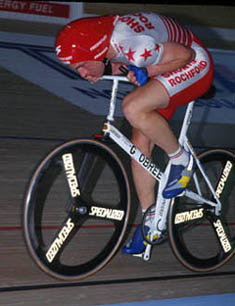
What makes Graeme the ultimate cycling purist is not just the unquestionable brutal reality of the one hour record but the fact that he raced on a bike he built and designed himself! In fact, it is just possible that triathlon has Mr Obree to thank for the invention of the aerobars and the aero-position, but we'll come to that in a minute. Obree was in many ways the antithesis of Chris Boardman, the technical cyclist who trained with pulse meters, knew where his lactate threshold was and, more importantly, had the best bike sponsorship money could buy. This is not to detract from Boardman who was an incredible athlete but rather to put Obree's achievements in context.
In 1993, Obree booked the velodrome in Norway for 24 hours so that he could attempt his record; he failed by nearly a kilometer. Incredibly, he came back the next day just an hour before his booking ran out and went for the record a second time. Imagine the pain his muscles must have been in even before starting! And even more incredibly, this time he managed to secure the hour record!
A week later, Chris Boardman who, to be fair, had already announced his intentions of breaking the hour record some time before, stole the record from Obree. What was worse was that the UCI (Union Cyclisme Internationale) decided that Obree's riding position was "illegal". Obree had invented a peculiar riding style (see picture) in which he tucked his arms under his body, like a ski jumper, for maximum aerodynamic efficiency (and minimum comfort, no doubt). It's true that it was a fairly dangerous way of riding as Obree himself demonstrated when he lost control of the bike - but it is always better to make rules proactively before they are broken rather than reactively.
This didn't stop Obree, oh no. He invented another riding position, perhaps inspired by a film he had seen.
![]() |
| Da dadadada, da da da! |
The UCI also banned this position and came up with some apparently arbitrary ruling based on the position of his seat. Nevertheless, Obree took back the hour record in 1994, gaining not only a sporting victory but a moral one. It seems like the UCI has learned its lesson and now states that the hour record must be completed on a bicycle similar to the one Merckx used in 1972. I have to say, I am in favour of this. Being a purist as I have said, I'd rather the winner was decided on the track and not in the laboratory or the work bench. Obree showed that, in spite of there being virtually no limits to the technology employed in the bike, even an amateur stood a chance (for the ball bearings in the bottom bracket he used some from his washing machine). However, nearly 20 years later with wind tunnel fashioned carbon fibre frames I'm not sure it would still be the case. I think that the sport of rowing has the balance right on this issue: any innovation which would price a significant part of the competition out of the market was banned. The most famous example of this is the ingenious idea of the sliding rigger with which Chris Ballieu beat Steve Redgrave to victory at Henley: instead of 100kg athletes thundering up and down the boat on sliding seats, why not allow the pivot point (rigger) to move instead? These boats still exist but are not allowed in any competition. There is also a minimum weight a boat can have thus putting a stop to the fierce search for ever lighter, stiffer (and more expensive) materials. In cycling, the rules are terribly confusing and complicated - it depends very much on the competition.
Obree not only fought his battles on the track: as a sufferer of bipolar disorder, he was prone to devastating bouts of depression. He has tried to commit suicide (thankfully with no success) at least three times. Last thing I heard is that he is writing a book on dealing with depression to follow up his excellent and thoroughly recommended autobiography "The Flying Scotsman". I also heard that he was planning to attempt the hour record again as recently as late last year. I think it is just as well that he didn't and, to me, shows me that he is winning that harder and more vital battle with himself.
On a side note, I can't help noticing how cycling and depression seem to be intimately linked. I suspect that the missing link is the word "obsession". Every year, it seems, another professional cyclist commits suicide (I've read that 3 of the 60 Tour de France winners have committed suicide which is a very abnormal proportion). Then there is Chad Gerlach, an American professional cyclist and past team mate of Lance Armstrong who has spent stints between competitions as a homeless crack addict. Although there is a big motivational difference between taking crack and human growth hormone, say, perhaps there is a reason in all this why cycling is the sport most often linked to drug offenses.
![]() |
| Chad Gerlach |
Senin, 20 Desember 2010
Unsung heroes: Andy Holmes
There seem to be two kinds of famous people in the world: those who are famous in their lifetime and those who have to die before they are recognized. Andy Holmes falls into the second category.
I got into rowing for the simple reason that the friend of mine with whom I went jogging said that it was easier than running "because you got to sit down". It certainly was at first - the guy at bow (at the front of the boat) used to row with one hand while smoking with the other - but, one day, I was plucked out of that boat and put into another one, by virtue of my height if nothing else. I can still remember being in the cinema with my parents (how long ago was that?!) when we bumped into my coach and he told us we would be rowing on the Thames in the Fours Head of the River race, over the 4.25 mile long Oxford Cambridge Boat race. Now I think of it, it was pretty crazy for that to be our very first race (it may not seem far in running terms but the Olympic rowing distance is only 2000m)! I remember thinking all the way along the course that I would stop after just ten more strokes and then apologize to my crew mates for letting them down terribly. But then I would find it in me to do another ten strokes and another... That day we overtook the senior men's squad from the club in their nice shiny yellow plastic boat (ours was a very sturdy wooden one) and that was the turning point from which I never looked back. From then on, it became very much a part of my daily life for the next 6 years.
Steve Redgrave and Andy Holmes quickly became adolescent heroes for me. At this time they had already won gold medals at the Olympic games in 1984 but, in spite of this, rowing was still very much a minority sport, limited to being a backdrop to Henley Royal Regatta or an excuse to go to the pub by the river once a year on Boatrace day. To give him credit, Steve Redgrave had to win 5 Olympic gold medals in 5 consecutive Games to really capture the public's imagination, somewhat helped by his spontaneous remark just after bagging the 4th one, that if anyone should see him near a boat again, "they have my permission to shoot me". Andy Holmes also won no less than two of those Olympic gold medals (and a bronze one, to boot) but not many people have heard of him. Matthew Pinsent who won the other three golds with Steve Redgrave is much better known, more than anything else, because he was at the tail end of Steve's career when the sporting audience had finally woken up to this amazing achievement that was unfolding.
For me, I still think of the original pair of Steve Redgrave and Andy Holmes - teenage worship doesn't get forgotten so easily. For some reason Andy and Steve split up and went their separate ways after the second gold and Andy eventually gave up rowing. It was a great shame because he was clearly an incredibly talented oarsman - anyone who can stop a boat that Steve is rowing in from going round in circles must be. It seems so very poignant and tragic that, 17 years later, Andy should finally get back into rowing, at a more low key level only to catch a rare water borne disease (Weil's disease) and die from the infection. I was very shocked to read this when it happened a couple of months ago and found a lot of old memories getting stirred up. We were always told that, if we should get a fluey cold then we should go to the doctor and inform him that we were rowers, so that he could check for Weil's disease.
![]() |
| Greg is the one on the left and, yes, they are all standing on the same step of the podium |
On a brighter note, while digging around on the internet to fill in some of the blanks in this post, I just noticed that Greg Searle - who last won an Olympic gold medal 18 years ago and had long since retired - is back in the running for the London 2012 Olympic team (when he will be 40)! Not only that, but he won a silver medal at the Rowing World Championships in November. This has filled me with irrational hope, that it's never too late.
Langganan:
Postingan (Atom)