Tampilkan postingan dengan label bike. Tampilkan semua postingan

Selasa, 10 Januari 2012

Urban cycling

After just having got back from London, which has done a pretty good job of retro-fitting facilities for cyclists to an old, crowded city, I was struck by the amount of newspaper print dedicated to a tragic bike accident in Barcelona. Please don't misunderstand me: it was a terrible thing to happen but it is also something that happens (unfortunately) every so often in London. Meaningless statistics were quoted claiming that riding a bike was 5 times as safe as going by car, given that the number of accidents relative to the population of bike users is five times less than it is in the car world. This would only be a fair comparison if it were restricted to inter-urban journeys: to compare road accidents at 120 kph on the motorway with those incurred while cycling to the local corner shop doesn't make much sense.

However, this particular type of accident is worryingly common. The cyclist rides is on the inside of a large truck, the truck decides to turn right (left in the UK) without having seen the cyclist and drags him or her under the wheels. Actually, I read that this more commonly befalls women than men. The reason that was speculatively put forward is that women tend not to be such aggressive riders as men and prefer to tuck themselves into the side, rather than confidently claiming the road ahead. In fact the same person that made this comment said that the common advice given by road safety authorities to keep in as close to the curb as possible (while watching for opening car doors) is actually wrong: cyclists have to be more assertive and claim a (reasonable) part of the road for themselves and BE SEEN if they are going to survive as equals.

Many steps have been taken in the UK to avoid this type of accident, perhaps the best of these being the Advance Stop Line (ASL) which is the box just behind the traffic lights which only cyclists are allowed to use. This makes sure that they are clearly seen by the motorists behind. Another innovation is for some trucks to have written on the side - "If you are here I can't see you in my mirror".

Still, the best defense against road accidents is to gain critical mass. Once cyclists become a common sight rather than a rarity, motorists will be sure to look out for them. Until then and even after, we have to ride imagining every possible scenario. Please be safe...

Senin, 12 Desember 2011

Time Trialing

To be honest, for me Triathlon is all about the bike. The only reason I got into it in the first place is because I am a bit big framed to be a fast runner and I have disproportionately strong legs (compared to the rest of my body) so I figured I could be handy on a bike. I can still remember a couple of years ago, when I bought my first bike since the road accident I had ten year's before, asking if for a Mountain Bike that was also good for Triathlon. They didn't take advantage of my obvious naïvité and sold me a decent Mountain Bike, patiently explaining that I needed a road bike - or what I used to call a "racer" - to ride in Triathlons. (Of course, there are such things as off road Triathlons but that's another story).

When I was buying the road bike I discovered that there were two kinds of Triathlon: those that permitted drafting and those that didn't and that, potentially, you needed a different bike for each although you could make do with one. But I wasn't interested in swimming or seeing how fast I could run off a bike, for that matter; what I was really looking for was a Time Trial in Spain. I imagined there must be loads of them up and down the country, just as there are in the UK - bike races where you are not allowed to draft off anyone in front of you and it is just you against the clock. For some reason there don't appear to be any such competitions in Spain for non-professionals.


I recently asked a friend who organizes Triathlons whether he fancied organizing a Time Trial in Spain, which surelly should be at least three times easier and cheaper. He said that that the Federación Ciclista expressly disallowed Time Trials run for profit. I wonder if you could get around this absurd restriction by obliging all competitors to run 100m to mount their bikes and calling it a Duathlon. Or perhaps one could be organized for charity? It seems a shame to me and perhaps goes some way to explaining why Spain dominates in Road Racing but not in Time Trialing or Pursuit. It's also probably due to the fact that road racers are generally smaller and lighter than time trialers as the main resistance they have to overcome is not that of the air but that of gravity.

I've sent an email to the Federación Ciclista Madrileña asking whether there are any Time Trials open to amateur "age groupers" like myself, and what the entry requirements would be. Still, I miss the grass roots amateur racing that exists in the world of running. I've also been trying to find out whether there is a velodrome reasonably near me and so far, all I have found out is that the only one in Madrid is in a state of disrepair. What Spain needs is a Cristóbal Hoy...

Kamis, 08 Desember 2011

What a beauty...

A prize for working out what is wrong with this picture...
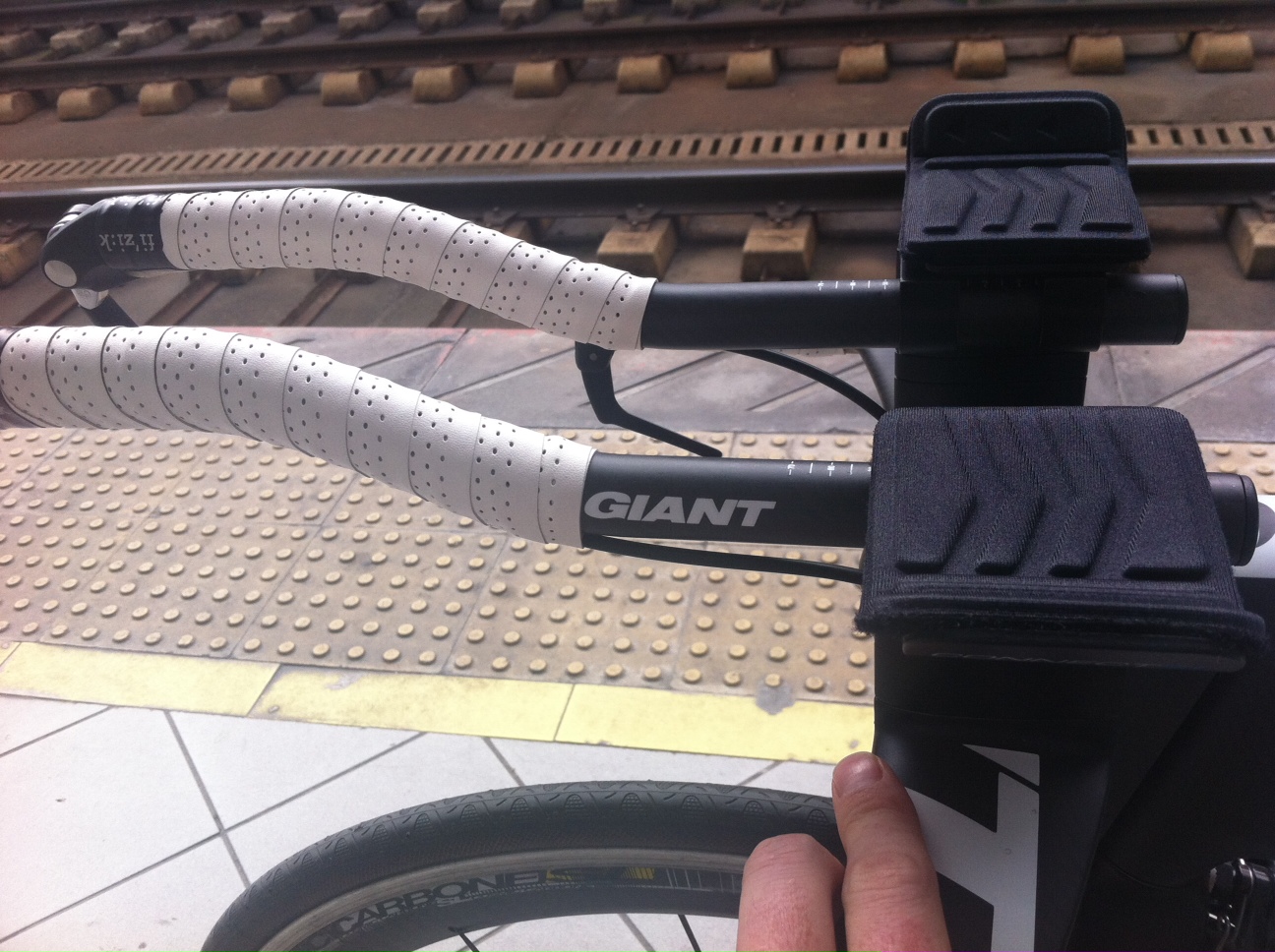
I've finally got all the bits and bobs for the bike - the last (or should say latest?) addition was the funky 4 spoke front wheel. Just the Darth Vader tie fighter whoosh whoosh sound of the back wheel combined with the helicopter chop chop chop of the front wheel makes you feel as though you are going faster, even if you are not.

I went for my first decent length ride this morning. The idea is to use the road bike with the "normal" wheels for training on the roads and to keep this one mainly on the turbo trainer to get used to the aero position (and for competitions, of course!). I had a few teething problems like the screw of the gear lever working itself loose and getting stuck in a high gear as a consequence. This was easy to fix but when the seat post nut came undone I didn't have the requisite tool to tighten it up again. I had to ride about 15 kilometers without sitting down - it felt like I was in a spinning class - before I found a gas station where I was able to fix it at least temporarily. But hiccoughs aside, it was great fun zooming along and it was nice to go back over the routes that I frequented when I was training for the Ironman (I was surprised to see that a whole bunch of new houses have popped up since then along the way). The Adamo seat is fantastic! Really comfortable - what a difference it makes being able to fully sit on the seat.

I did find it quite tiring on the arms being in the aero position. I think the position is good but it is very low down for this early in the season: normally you start higher up and work your way down. Also my pulse rate was on the high side the whole time but, for now, I don't care. Once I start training seriously for the Half Ironman in April, I'll have to hold back a little and be patient while the speed gradually comes back.

Sabtu, 03 Desember 2011

Estoy como una cabra (Bike Fitting part II)

I went back to Ciclos Delicias on Saturday to have my new seat, pedals and Rotor crankset (this time with the correct rings: 53 and 39 teeth respectively). The first nice surprise was that Rafa had managed to get me the top of the range Look Carbon Blade pedals for the same price as the ones I had ordered: instead of having a little spring, they shave off a few extra grammes by using a lamina of carbon. I'm not sure whether the "TT" (Time Trial) cranks really have any noticeable aerodynamic benefit but they sure look sexy.

As the Spanish say, "What a cucumber"
While I was waiting for all the new bits and pieces to be fitted, I got chatting to a guy who came into the shop with a Ceepo Triathlon bike. He turned out to be Fran Vacas, the current holder of the 1,000km (!) road record, which he managed to complete in just over a minute over 31 hours in May this year. We talked about Ironman at which point he showed me a pretty cool tattoo which he has on his calf. It struck me that, for someone with a couple of World Records, he should only have a tattoo commemorating the Ironman. He told me that he did it a year after the event, so there is still a chance I might do one...

A friend of mine, John Warnock, who I used to row with back in the late 80s has since turned to cycling and, like Fran, competes in ultradistance. He has won the UK National 24 hour Time Trial and has also recorded the second furthest distance travelled in the UK in 24 hours. Perhaps I can try to hook him up with Fran. John recommended me the Adamo saddle and I figured that if someone knows about saddles, it has to be him (although it is true that every "bum" is different). Come to think of it, John was also the person who put me on to the Pose Method for running in the first place.

Let it all hang out...
As you can see, the Adamo saddle has a radically different design. As I find myself always sitting on the very end of my saddle, I thought it might be more comfortable to sit on the very end of two points of the Adamo saddle. More on this later...


Next I did a bike fitting - if you read it at the time, you'll remember that I wasn't terribly satisfied with the whole procedure. This time it was much better (it wasn't the same guy - in fact he is no longer working with the company). We spent a lot of time fiddling about moving the seat backwards and forwards and angling it up and down before we had to take the inevitable step of cutting the seat post. The design is such that the seat post has to rest on top of a stop inside the frame. You are provided with several different sized spacers that you can combine to be able to move the seat up and down by up to almost 3 cm, in increments of a quarter of a centimeter. We estimated that the seat needed to be lowered by one centimeter so we decided to cut 2 cm and add a 1 cm spacer. It was time to call in the "Bulgarian Butcher"...

This was harder for me to watch than the film "Saw"
A good tip is to keep the little piece that has been cut off because this serves as a spacer itself and, in the event of selling the bike to a taller person, it might be necessary. Once we had made all the adjustments, the end result was that the saddle was set quite far forward right over the bottom bracket, not quite at the maximum but too far forward to be compliant with the UCI rules! We also moved the armrests and the extensions back so it was absolutely clear to me that I got the right sized frame (an "M" as opposed to the much longer "L"). The main criticism of the Giant Trinity Advanced SL is that it is not very adjustable in the horizontal plane; in the vertical plane you can move the handle bars up and down by 12 cm using the different nose cones (which I don't yet have). For the time being, I'm keeping the handle bars where they are (because I don't have any choice) - this gives me quite an aggressive (i.e., aerodynamic) position but the question is whether I will be able to keep the position without getting too tired in a Triathlon, bearing in mind that you have to run after the bike. The second nice surprise of the day was that Rafa said that the bike fitting was free!

Camel toe

I promised I would say something about the Adamo saddle. In spite of the fact that I was still quite sore from the Marathon, I immediately took to the Adamo. My habit from having to perch on the previous seat (in order to avoid pressure on the perineal zone) meant that I tended to sit too far forward on the Adamo. To my surprise, once encouraged to sit further back,  I found that it was actually much more comfortable than I expected. We angled the seat in such a way that I wouldn't keep sliding forwards. So now, not only am I supported by two points rather than one, but I am much more supported than previously. It will take some time to get completely used to - in particular I have to overcome my habit of sitting to one side of the seat - but the initial indications are very good.

So far so good. Before even seeing any results in speed, the new bike, the seat and the bike fit have met my expectations in terms of being able to ride in a good aerodynamic position and in reasonable comfort. Now I have to put in the kilometers and get used to the position and we'll see how much better things are then. If needed, I can always raise the handlebars up slightly if I find that I still get unduly tired from being in the aero position.

Sabtu, 19 November 2011

Bike aero position

Here's my first attempt at an aero position on my new bike. So far I've done nothing more than just move the seat post height half a centimeter. There are all sorts of adjustments I can try form moving the handlebars down to the seat further forward. It is a big improvement on my best position on my road bike.

Before...

...and after
Second attempt after moving seat back a little
For reference, Timo Bracht in the 2010 IM in Hawaii

I had thought I might not need to sit so far forward on the seat, now that there was no real restriction in how far forward I could move it but it is simply uncomfortable to put my weight any further back on it while I am leaning forward. An alternative would by the Adamo seat which is a bit like a sawn off shotgun and is predicated on the idea that you sit on the edge - or, in this case, the two edges.

The other thing I notice is that my back tends to curve. This is partly to do with my lack of flexibility but it perhaps could do with straightening out a bit by extending the distance between the points of contact of my elbow and my bum. Still, the main thing is that it feels relatively comfortable (we'll see after several hours if I am still saying that) and I believe it is pretty aero in that i am presenting a compact surface area to the oncoming wind.

I've got my goat

In Spanish, a triathlon bike is referred to as a "cabra", or "goat", presumably for the resemblance of the handlebars to the horns of a goat.

Today is my eldest son's 9th birthday (I am writing this in the cinema during a particularly tedious film). I should be buying him a new bike, surely, not me!

After months of investigation, trying out different frames and seeing whether I could get a good "0 kilometer" deal (ex-exhibition), I finally settled on the Giant Trinity Advanced SL frame with Ultegra, Rotor cranks, Zipp 900 disc wheel and Xentis 4 spoke TT Mark I front wheel. All this for less than half the price of the Trinity Advanced SL model featured in the catalogue, with its electronic group set. After the Ironman I did back in May, the only thing that hurt was my back - and the discomfort lasted two weeks. I am hoping that this bike will help me tolerate much better the aero position (flat backed, low, stretched out riding position). It bloody had better do because my marriage let alone my bank account won't survive another bike purchase on this scale.

Buying the bike was like walking into a bar with Scarlet Johansen on my arm; the same mixture of embarrassment and pride having everybody staring longingly in my direction. The difference, of course, was that I let them caress my newly acquired beauty and even lift her up to feel her weight. A guy came in with a retro single speed - something unusual in hilly Madrid - and when we caught each other in mutual bike admiration he suggested a swap.

In the end the bike was missing a few of the bits and pieces I had ordered because they hadn't yet arrived. Nevertheless, Rafa, who runs the Ciclos Delicias shop, leant me a fetching purple saddle and some brand new pedals so that I could at least try out the bike while we waited for the parts to turn up.

It was also weird walking through Delicias - which is a slightly run down part in the suburbs of Madrid - with a space age bike. On the train home an elderly man started talking to me about the bike, reminiscing about how he used to ride 200 km and back in a day, or how he climbed puertos that even cars struggled to go up. Looking at him he had that impish air of a cyclist, small, lean and with a sparkle in his eye. He told me that he used to ride with wheels that had wooden rims.

Needless to say, the bike is amazing. Certainly much more amazing than my ability to move it. The image of me with Scarlett Johansen is probably an appropriate one: I've traded up. Every so often I read a letter or an article in a triathlon magazine or forum, in which someone is boasting about how many people on much more expensive bikes he (it is always a "he") has overtaken in a race or even in training. I suppose it is easy for me to say but I can't help feeling sad when I read these kind of comments, that somehow the author is making excuses and limiting themselves. What I like about the Ironman distances is that it is just you against the wind and the current (unless you are in contention for winning overall, of course). Doesn't stop you from coveting other peoples' bikes, though, much like eyeing up another guy's girlfriend.

Some sports have adopted stricter rules to keep the technological advantages at bay, thus reducing the barrier to entry. Long distance triathlon is not one of those sports. I am privileged to be able to ride a true marvel of human engineering.

The soft focus wasn't intentional...

Selasa, 15 November 2011

Commuting

I promised I would post a photo of the "Bike Parking" signs that have sprung up at my work. I love the design. Looks like it was done by a triathlete. (I just noticed that it looks like it says "Poo".)


I'm dying to get back on the bike and to make use of the new "facilities" at work. Just a couple of weeks to go until the Marathon and I'll go back to commuting a few days a week.

Selasa, 08 November 2011

If at first you don't succeed...

...be a pain in the arse until you get what you want. Finally, we will be able to go round the work campus on bikes as of the 10th of November!


All cyclists must come in to work via the "B" entrance which is a few kilometers away from the gym (the "P" at the far left of the map) from where I then have to make my way back (in my suit) to the "P" in the middle which is nearest my office. Where there is no path we are supposed to go on the pavement. It adds a bit of faff to the whole thing but it is better than nothing and, in any case, a few extra kilometers are welcome. The rules stipulate that the speed limit (40kph) must be respected at all times but I can't really see myself getting up to that speed on the pavement. There is also a rule which looks like it has been taken straight out of the Ironman regulations: overtaking must be performed within 15 seconds or 100m, leaving a margin of 1.5m. One good thing is that they enforce the use of a helmet (something I was lazy to wear with my suit).

There is a serious problem with parking on campus as we are 6,500 employees. I'm hoping that other people will start to either bring in foldable bikes in the boot of their car to get from their distant parking spot to the office or to leave a bike permanently in the racks to move from one place to another. The next step is to get a "critical mass" of cyclists so that - who knows? - we can look forward to having a shower installed in our office (avoiding the trip to the gym) as is the case in most workplaces in London.

Senin, 24 Oktober 2011

Extreme aero bikes


Now something I have never really understood is why there seems to be no market for "extreme aero bikes" like those in the photos. Most of them never made it past the prototype stage and those that did (including the Hotta, which Natasha Badman rode to victory a number of times), are now only available second hand. The most recent activity seems to be in the form of the Cycpro bike but, as far as I can tell, that has also come to a dead end.

Let's look at the facts. According to Bloomberg, the average salary of an Ironman competitor is $161,000. To be clear, it is not talking about the average salary of the professional athletes but of the average salary of the so-called "age-groupers", or people who compete in triathlons as a hobby - in other words,, what they get paid for not competing in Triathlons. And it's not altogether surprising why: just the race entry to the recently inaugurated New York Ironmman is in excess of $1,000. This, is of course, less than many Ironman competitors would spend on their front wheel.

The other fact is that the bike rules for Ironman distance Triathlon are much more lax than the UCI rules for time trials or the ITU rules for Olympic distance Triathlon. Here is an excerpt from the Official Bike Rules for the Ironman World Championship:

1) All athletes are required to ride road/triathlon bikes. Mountain bikes, beach cruisers and bikes with coaster-type brakes are prohibited.


2) No tandems, recumbents, fairings, solid wheels, wheel covers or any add-on device designed exclusively to reduce resistance are allowed. Any new, “unusual” or prototype equipment will be subject to an evaluation of legality by Ironman and/or USA Triathlon’s Head Referee.

Although the rules vary slightly from Ironman to Ironman, most of them do not even include point (2) so, as long as you don't rock up on a Mountain Bike (how uncool would that be? ;-) ) you can pretty much ride anything. Now I think they would draw the line at a tandem or a recumbent but I have seen some pretty wild looking bikes at the Ironman in Brazil and I myself used a wheel cover without any problems (many others had disc wheels).

Is it because people are worried that they might be turned away if they arrive at the start with a bike that is just a little too funky? Surely it would just be a question of giving away a few bikes to some top age-groupers to allay these fears and paying the WTC Ironman Corporation some cash for advertising would no doubt seal the deal. Why is it that we instead are willing to pay huge sums of money to mainstream bike manufacturers to buy what are essentially replicas of bikes that they have developed for the Tour de France with its restrictive UCI ruling? Could it be because these bikes have a more versatile fit?


Guru is a bike manufacturer which takes a slightly different tack. They (quite rightly) point out that most of the aerodynamic drag comes from the rider themselves and not the bike. So little good does it do you to have the most aero bike if your position on that bike is not optimal and you end up presenting a bigger surface area to the oncoming wind. They are able to offer made-to-measure carbon frames (which, by the way, are also very aero even if not the best of their class). OK, so my point is, if Guru have managed to have developed the technology to make bespoke carbon frames, why is it that no-one is able to bring to market a monocoque design like those crazy beasts in the photos, one that could be adapted to the dimensions of the rider and at a price affordable by the average Ironman? I can't help feeling that the answer is a very cynical one: that in the end we all get sucked in by the big brands and their marketing.

Senin, 03 Oktober 2011

Bike exhibition

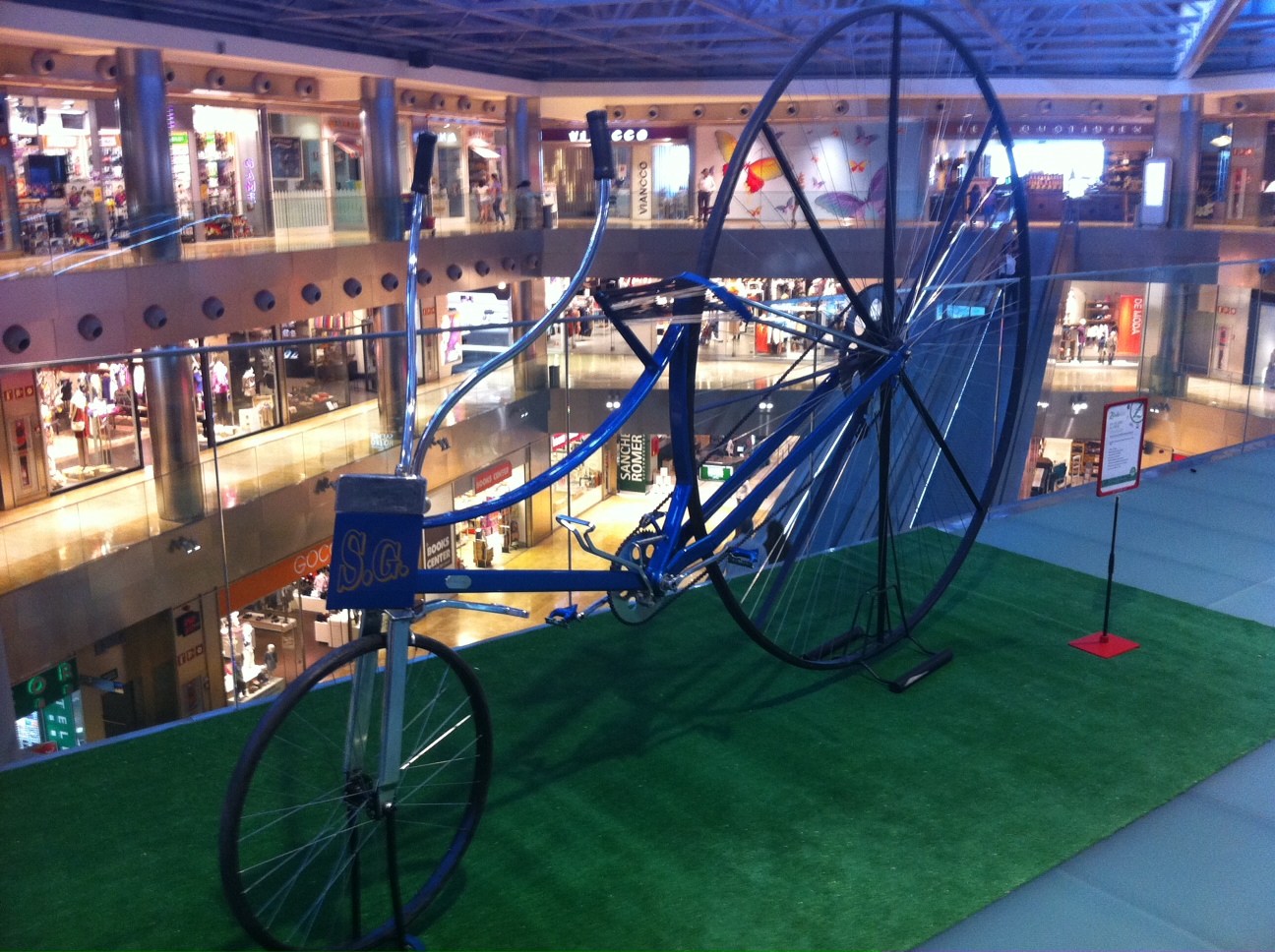
We ran out of Nespresso coffee yesterday so we made a trip to the swanky new shopping center in Pozuelo, "Zielo". What was a nice surprise was to see an exhibition of antique, replica and concept bikes.

Check out the detail of the end of the top "tube"
A concept bike: you actually ride inside the wheel
Detail from above
My personal favourite
Couldn't find this excellent bike map on the council website

Jumat, 05 Agustus 2011

Bike fitting

I used to be skeptical about bike fitting until I paid up and did one myself; now I am VERY skeptical about bike fitting. I'm not going to mention any names (unless you get in contact with me directly) because bad reviews and complaints have a tendency to reproduce like rabbits on the internet and end up being taken out of context.

The thing is, I'm planning to buy a triathlon (aero) bike not only because I think it will make me go faster - which is always nice - but because I'm hoping to avoid the severe back ache I had for two weeks after doing the Ironman. Bike fitting is about finding the best compromise between aerodynamics, application of power and comfort. With my current bike this compromise is somewhat restrictive. The first part of the bike fitting involved being "fitted" on my current bike so that, not only could I get the best out of it, but the idea was to get recommendations of triathlon bikes that would suit me best and - most importantly - be advised on what size frame to go for. The last thing I want to end up doing is shedding a whole load of cash on yet another bike only to find that I am just as uncomfortable (and just as slow). All the different triathlon frames have different characteristics and vary how forward you are with respect to the cranks (seatpost angle) as well as the length (reach) and height (stack). So if you have relatively short legs with respect to your torso you'll want a bike with a longer reach for example.

First of all I got on my current bike (mounted on a turbo trainer to measure my power output) and some measurements were taken with a kind of protractor in order to determine my optimum seat height. Since I would be buying a triathlon bike it seemed to make sense to set up the road bike for a road position: this resulted in lowering the seatpost by about 3 millimeters (at a cost of about €50 per millimeter being the only adjustment that was made). To be honest I think that I am perfectly capable of sensing where the optimum seat height is but hey, it's nice to have it confirmed by an expert. If I decide to ride with the aerobars on this bike I'll have to raise the seatpost by those 3 millimeters again. There was a screen in front of me spitting out wattage numbers that no-one seemed to give any importance to but it certainly looked impressive and technical.

Well who cares about the old bike anyway? What I was really interested in was choosing the most suitable triathlon bike for my body shape. I expected the fitters to have tables of measurements from all the major manufacturers, all converted into some consistent format. Instead it was a case of me suggesting a brand that I thought was "cool" and the fitter looking on the website at the quoted dimensions and saying that it was too long, too short, too aggressive, too relaxed. What really annoyed me was that, in many cases, I knew more about the bikes in question than the supposed expert. In any case, he was basing my ideal measurements on my road bike with no clever adjustments to account for passing from a road position to an aero position or anything like that. I couldn't shake off the idea that I was being goaded in to buying a custom bike. These bikes (made by Guru) are carbon fiber bikes that are made to measure and are as expensive as that sounds. Don't get me wrong, they look amazing but if there is an off-the-shelf bike out there that fits me, then my money would go much further on the groupset and the wheels, for example. The point is, how can I be sure that the measurements were taken well enough for even a custom bike to be a good fit? I mean, they took a photo with their iPhone of me standing next to a screwdriver (for scale) so that they could supposedly get any measurements they needed, so I wasn't exactly filled with confidence. Bizarrely, the fitter also offered me a second hand Giant Trinity Advanced SL0 that belongs to Virginia Berasategui, a Basque professional triathlete, in size "S" for small! (I'm 6"2).

Anyway, the reason I post this now is because I came across a very interesting article in Triathlon Plus, written by Chris Boardman (British Olympic Gold Medalist in cycling). If bike fitting seems to me a bit like the black art of voodoo then it was refreshing to see someone - and not just anyone, mind - demystifying the whole bike fitting process. There are some very practical suggestions for how you can improve the fit yourself. Here's a link to the article.

Senin, 21 Februari 2011

Bike porn

The top ten finishers in Kona (Ironman World Championships in Hawai) 2010


(By the way, if you got here by searching for "Ironman Porn" don't worry, you are not alone - last month 7 people were looking for the same thing as you.)

Selasa, 14 Desember 2010

A stroke of luck

I finally got my bike back today with its Rotor crankset (see previous post) so, naturally, I was keen to try it out.

Just as well I took the bike for a spin on the indoor rollers because, after 20 minutes, a bit fell off and one of the crank arms worked itself loose! I dread to think what might have happened at 30kph, on a road miles from home. As I said, a lucky stroke. Literally.

Oh, the Rotor Q Rings are the business - the pedal stroke feels much more even already. Could be the placebo effect but who cares when it looks this cool?

Minggu, 12 Desember 2010

Books

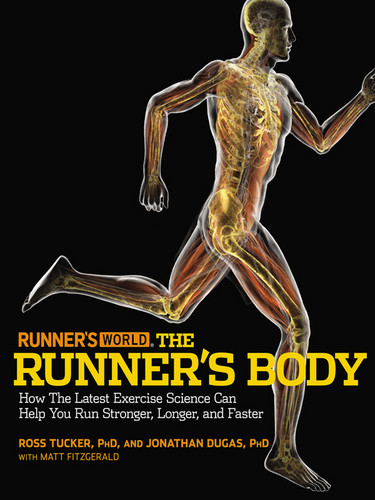
If you only buy one book on running, then buy this one. It should really have been called "The Bible of Running", although it's true that I most probably would not have considered buying it had that been the case. It is a pretty hefty tome and goes into a lot of technical detail but it is not meant to be read from cover to cover; rather it is a reference book. It has chapters that go into great depth on heat evacuation - if you are a regular on this blog then you'll know that this is one of my pet subjects - on energy systems, on technique and on injury prevention and recovery. What sets the book apart for me is the section on training: it has case studies from some of the most famous and successful athletes and coaches, including excerpts from their training programmes. The book is orientated towards running but it is of interest to anyone involved in endurance sports.


Tim Noakes is one of the most respected researchers in the field of Sports Science. From the same stable comes "The Runner's body", two of the authors of which hail from the same University in Cape Town. In fact, these two - Ross Tucker and Jonathan Dugas - are those responsible for the excellent Sports Science Blog.

What is most surprising about the book is that, in spite of being endorsed by Runner's World - a magazine which appears to make a living out of trotting out the same old hackneyed populist articles year in, year out - is that it proceeds to debunk pretty much every myth about running there is. I was already familiar with the myths about drinking to replace lost body weight, about lactate acid causing fatigue, about pronation and motion control shoes, about cramps and electrolyte imbalance but there were a couple of new ones for me too: namely, the myth that VO2max is an unalterable determinant of your running potential and the myth that you can never do too much stretching. On this last point, according to the popular thinking on stretching, the one single adaptation that the body makes in response to running that is detrimental is that the muscles shorten and become less flexible. It does seem strange that we should have evolved in this way if it were truly detrimental; however, the authors claim that the rigidity increases the energy return in the stretch-recoil response of the muscles and that too much flexibility actually slows you down. I'm quite pleased about that as I have always been rubbish at stretching. (This is a good example of how we choose to believe what suits us.)

This book is by no means a smart-arse attempt to be contrary or, indeed, to fuel conspiracy theories. It is, if you like, the equivalent in the field of Sports Science to books written by Steven Hawking for the layman (except that it is somewhat more credible). The sports science that filters through running circles and running magazines corresponds to research which was current a number of years ago; just as in any science, the paradigms are always shifting and human knowledge is becoming more profound.

"The Runner's Body" has a good section on nutrition which is clearly based on the same ideas as the latest offering from Matt Fitzgerald. If the above authors are the equivalent of Steven Hawking, then Matt Fitzgerald would be Simon Singh: that is to say, he is not himself a sports scientist but he is very good at doing the leg work and writing up his findings in a way that anyone can understand and appreciate. What I found particularly interesting was seeing what athletes actually ate (bearing in mind they may be contractually obliged by their sponsors to say they take certain products). There is also a chapter with some healthy recipes that looks worth me trying my hand at. I've already talked about my success in losing body fat in a previous post - that was all thanks to this book.


Matt Fitzgerald has also written a book called "Brain Training for Runners" which is also very good, if not a little bit spun out. In this book he expands on what is essentially Tim Noakes' "Central Governor" theory that fatigue in exercise is induced by the brain so as to avoid catastrophic damage (or death). Of course, just as anyone who has suffered from a mental illness will be too aware, this doesn't make it any less insurmountable. Still, there are a number of implications and this book studies what you can do to improve your performance.

It's difficult to choose between the two books on Pose Running by Nicholas Romanov but this is the more recent one and some of the ideas are a bit more polished. There's also a nice appendix where you can see the results of studies that were done on the ground impact forces during running. It is, as its name indicates, a book on triathlon - certainly the sections on cycling and swimming are interesting - but I can't help feeling that he is stretching the point by giving so much protagonism to gravity in the development of these techniques. It is reassuring to see that you come up with essentially the same ideas that have been already dealt with in other books that specialize in these sports but to insist on the subtle differences I think detracts from the overall aim. As I have mentioned before, it was strange to me that running was considered to be the only sport whose technique was magically bestowed upon us at birth, never to be lost, and so it should be no surprise that the community of sportsmen that really brought the Pose Method into the spotlight were the triathletes, all too aware of the importance of technique in swimming and cycling. This book goes some way to completing the circle.

I'm a pretty terrible swimmer so you'd be wise to take any recommendation of mine for anything to do with swimming with a pinch of salt. Bear in mind that beginners have learnt to swim (properly) more recently than experts and so remember the experience more clearly. I did a weekend of Total Immersion classes and went from covering a 25m pool in 22 strokes to covering that same distance in 15 strokes. In swimming, the number of strokes you take for a given distance is a good measure of your efficiency. I went back to 22 strokes the next day but at least I know what I am supposed to be doing - it is just a question of putting my mind to it.

Many people say that Total Immersion is nothing new - that all modern swimming techniques put emphasis on buoyancy (hydrodynamic body position), moving your body past your hand rather than ripping your hand through the water etc. The distinguishing features of Total Immersion seem to be that (a) it is aimed at long distance (and especially triathlon) swimming, encouraging a very economical two beat kick and (b) that, instead of separating the upper body from the lower body, you work on the whole kinetic chain from the ankle to the shoulder, rather like a golf swing. You are positively deterred from using kick boards, fins and pullbuoys. The technique made a lot of sense to me as I could see the parallels with rowing.

I haven't yet found any really  good cycling books for triathlon. I think this is because the cycling leg of the triathlon (especially the Ironman) is so different from most other types of cycling - with the exception, perhaps, of time trialling - that it tends to get covered in triathlon books which cover the other two sports as well. These three are all good (I even bought the Joe Friel book in spite of it proclaiming itself a "bible") especially if you are new to triathlon, as I was this year. There are so many details you need to know, much more than just three sports but also the two "extra sports": the transitions T1 (from swim to bike) and T2 (from bike to run).

Rabu, 17 November 2010

My new secret weapon

It doesn't take a genius to come up with the idea of an "ovalized" or elliptic chain ring (that's the big cog connected to the pedals): there are sections of the pedal stroke which feel harder than others simply because you are using your body weight to move the pedals round and gravity only acts downwards; with an elliptic chain ring, the effective gearing changes throughout the stroke to compensate. The genius is in how to market such a thing in the year 2010 when Shimano famously flopped with this idea - the fatally flawed Biopace rings - back in the '80s.


What I couldn't understand until recently was, why on Earth did they put the hardest gearing at the "dead point", when your feet are at 12 and 6 o' clock? Surely this just makes it even harder! You have to remember that the motto of the 80's was "NO PAIN, NO GAIN" and so anyone who complained that something was "hard" was just being a pansy. The idea was, for a constant cadence, to increase the bike speed via the harder gearing to compensate for the ineffective dead spot. I actually got a chance to try them out when I borrowed a friend's bike to train on during my summer holidays in the UK: my friend said that he had stopped riding it because - surprise, surprise - it hurt his knees.

Nowadays, of course, its all about being more efficient, avoiding injuries and overtraining, massages etc. How easy the elite athletes of today have it (only kidding)! This translates into a simple 45-70 degree rotation in the elliptic rings et voilà - you have the Rotor Q-Rings. The gearing is such that you can get more work on in the part of the stroke where your muscles and gravity are working together (and it is easier to get past that sticky dead spot). What Rotor has managed to do where all others have failed, is shake off the skepticism and derisive laughter that has tended to accompany all but the roundest of chain rings. They have even used by several riders in the Tour de France.


So I was pretty astonished to find them in my local department store. Its probably because they are designed and made in Spain but, still, you can't even buy a bike that is not a mountain bike in the same shop. There being a recession and all, I thought I would do my bit to help Spain out and to reduce the PIGS to just a PIG.

(By the way, according to the Rotor manual, elliptic chain rings have been around since 1890. In those days they were neither optimised for speed nor for efficiency but for comfort: the maximum gearing was in the horizontal position and the minimum gearing was at the dead spot. This is surely a tribute to the advances of modern technology, that in just 120 years - a mere sneeze in time scale of Human Evolution - we have gone full circle. I mean ellipse.)